
Table of Contents
- Why 3D Printed Fidget Toys for Stress Actually Work
- Top 3D Printed Fidget Toy Designs Ranked by Satisfaction
- Articulated 3D Printed Figures That Double as Fidget Toys
- Best 3D Printed Desk Toys for Your Workspace
- 3D Printed Sensory Tools: Filament and Finish Matter
- Print Settings, Tolerances, and Troubleshooting Print-in-Place Failures
- Safety, Ergonomics, and Customizing Your Fidget Toy
- Conclusion
Last Updated: August 19, 2026
Why 3D Printed Fidget Toys for Stress Actually Work
3D printed fidget toys for stress tap into a well-documented connection between repetitive hand movement and nervous system regulation. When your hands engage with a satisfying tactile loop, your brain's threat-response quiets down, making it easier to focus and decompress.
At Bandit's Print Den, customers who order our desk buddies and fidget pieces describe the same pattern: the toy starts as a curiosity and becomes a daily habit. The sensory stimulation from a smooth-spinning gyro or satisfying click-snap mechanism gives the restless part of your brain something to do while the rest of you works.
According to American Psychological Association's overview of stress and the body, physical activity, even minor repetitive motion, can interrupt the stress cycle and reduce cortisol. The key is that the object must be engaging enough to hold your attention without demanding it.
3D printed fidget toys are uniquely suited to this. Unlike mass-produced options, they can be calibrated for a specific tactile experience: the resistance of a flex design, the friction of a spinner, the snap of a clicker. That precision separates a genuinely useful sensory tool from something that ends up in a drawer after three days.
Top 3D Printed Fidget Toy Designs Ranked by Satisfaction
Not all fidget designs deliver the same sensory payoff. The designs below are ranked by how consistently they become objects people reach for every day.
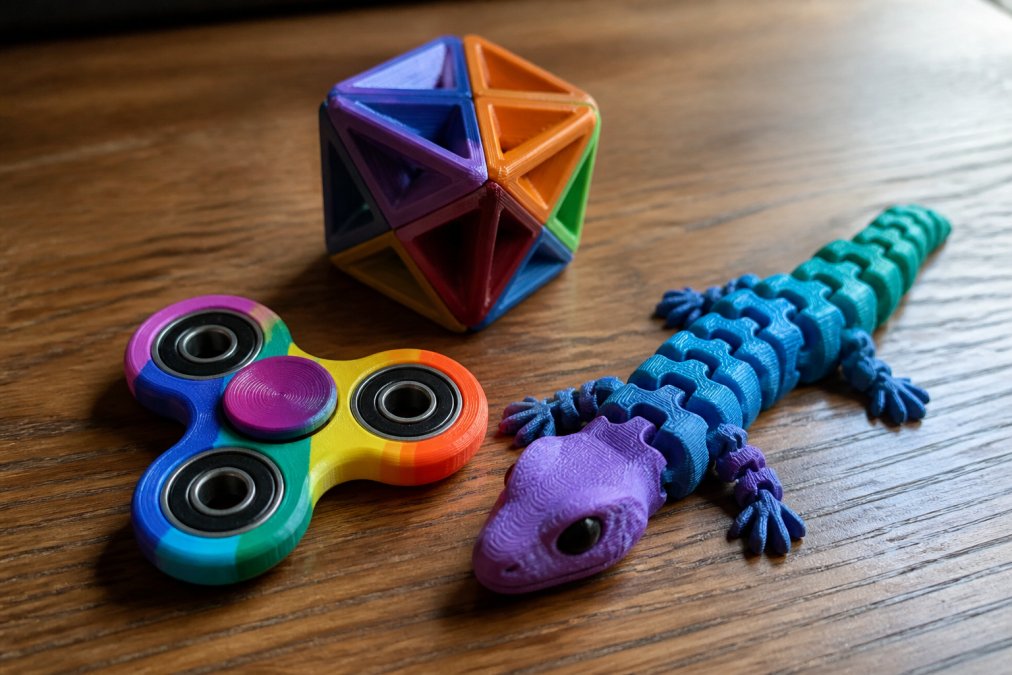
| Design | Tactile Type | Skill Level | Best For |
|---|---|---|---|
| Print-in-Place Spinner | Spinning, smooth rotation | Beginner | Desk use, light fidgeting |
| Infinity Cube / Geometric Folder | Folding, clicking | Intermediate | Focus and repetitive motion |
| Gyro Ring / Mechanical Spinner | Mechanical, multi-axis spin | Intermediate | ASMR, satisfying movement |
| Articulated Snap-Fit Clicker | Snapping, tension release | Intermediate | Stress relief, tactile feedback |
| Handheld Flex / Squeeze Design | Compression, flex | Beginner | Anxiety, hand strength |
1. Print-in-Place Spinners
Print-in-place spinners are the gateway design for anyone new to 3D printed fidgets. The entire mechanism prints as a single piece with the spinning element already assembled inside the frame. No hardware or post-assembly required.
A well-tuned spinner with the right layer adhesion and tolerance settings will spin for several seconds from a single flick. The sensory feedback is quiet and rhythmic, ideal for office environments. The critical variable is tolerance: most successful STL files specify a gap of 0.2-0.3mm between moving surfaces. Calibrate your printer before the first run.
2. Infinity Cubes and Geometric Folders
The infinity cube converts skeptics. It's a series of hinged geometric panels that fold in a continuous loop, the motion is almost hypnotically satisfying. The repetitive folding action is particularly effective for stress relief because it gives your hands a defined, cyclical task.
Most infinity cube STL files print as separate panels that snap together using integrated hinges. The snap-fit connections need 30-40% infill to handle repeated flexing without fatigue cracking. The geometric precision also makes them visually compelling as desk toys.
3. Gyro Rings and Mechanical Spinners
Gyro rings are the mechanical showpiece of the 3D printed fidget world. Multiple concentric rings rotate independently on interlocking axes, creating a multi-directional spin that's genuinely mesmerizing.
These require precise tolerances between rings, and any warping during printing will cause binding. Bed adhesion is critical; a brim or raft is often necessary for larger designs to prevent corner lift. According to National Institute of Mental Health's page on managing stress, finding physical outlets for stress is a consistently recommended strategy. A gyro ring gives you a genuinely engaging mechanical object during high-pressure moments.
4. Articulated Snap-Fit Clickers
Clickers offer tension and release: you flex the mechanism, it builds resistance, then snaps back with a satisfying click. That cycle mirrors what your nervous system does when stressed, and physically enacting it in a low-stakes way can be genuinely calming.
Articulated snap-fit designs rely on the flex properties of the filament. TPU is preferred because it can be flexed thousands of times without cracking. PLA will eventually fatigue and snap at the hinge point. The snap volume matters too, STL files often come in variants with different wall thicknesses that control snap intensity.
5. Handheld Flex and Squeeze Designs
Handheld flex designs are ergonomic shapes sized to fit a single hand that compress and spring back when squeezed. They're the 3D printed equivalent of a stress ball with more design precision.
The best designs account for hand size and grip strength. A flex toy that's too stiff becomes uncomfortable quickly; one too soft provides no resistance feedback. TPU at 95A hardness is a common starting point for medium-resistance squeeze toys.
Articulated 3D Printed Figures That Double as Fidget Toys
Articulated 3D printed figures are fully jointed designs where every segment moves independently. What makes them work as fidget toys is the combination of visual appeal and tactile engagement. You're not just spinning something; you're posing and repositioning a figure that has personality.
Bandit's Print Den specializes in this category. Our articulated figures are printed with the kind of joint tolerance and surface finish that makes movement feel smooth and deliberate. The key design consideration is joint resistance: too free and the figure collapses under its own weight; too stiff and manipulating it feels like a chore. The sweet spot is a joint that holds its position but yields smoothly to light pressure.
Best 3D Printed Desk Toys for Your Workspace
The best 3D printed desk toys serve two functions simultaneously: they look good enough to leave out and they're engaging enough to reach for during a long call or moment of frustration.
For workspace use, priorities include:
- Size: Handheld or slightly larger. Anything bigger than a tennis ball feels like clutter.
- Noise: Low to silent. Spinners and flex designs win here.
- Visual appeal: Geometric designs, articulated figures, and smooth-finish prints look intentional on a desk.
- Durability: Desk toys get handled constantly. Designs with thin walls or fragile snap points fail within weeks.
The best options include compact gyro rings, small articulated figures, and geometric infinity cubes. All hold up to daily handling and look considered rather than juvenile.
3D Printed Sensory Tools: Filament and Finish Matter
3D printed sensory tools are only as good as the material they're made from. The filament you choose determines the weight, texture, flex, temperature feel, and durability. For fidget applications, this isn't secondary, it's the whole experience.
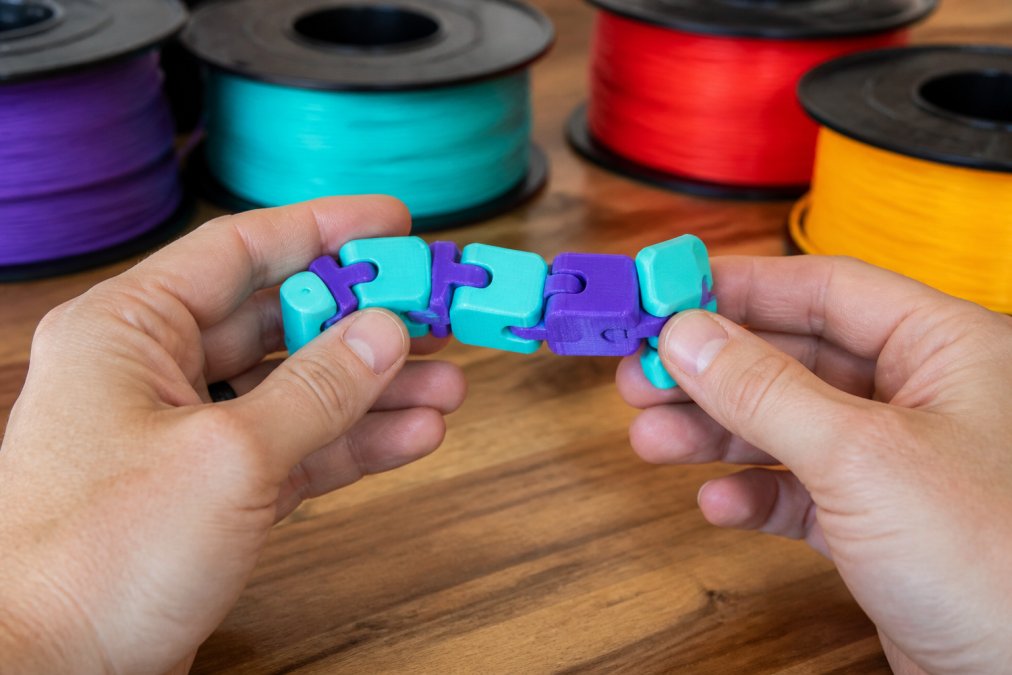
Choosing Filament for Tactile Feedback
PLA is the default for most 3D printing. It's rigid, prints cleanly, and produces good surface detail. For spinners, geometric cubes, and articulated figures, PLA is solid. The limitation is brittleness: flex it repeatedly and it will crack. Not ideal for clickers or squeeze designs.
PETG offers more flex than PLA with similar print quality. It's slightly softer to the touch and has subtle translucency. For print-in-place designs where joints need to release cleanly, PETG is often better.
TPU is the material for anything that needs to flex, compress, or snap repeatedly. It's rubber-like, highly durable, and produces a warm, soft tactile feel. The tradeoff is that TPU is harder to print: it requires slower speeds, careful retraction settings, and a direct-drive extruder.
Silk PLA adds a glossy, metallic sheen that makes finished pieces look more premium without changing mechanical properties.
Post-Processing for Smooth Movement
Post-processing is where professional results diverge from hobbyist ones. Raw print surfaces have layer lines, which create friction in moving parts and a slightly rough feel in handheld pieces.
For smooth movement in print-in-place designs, light sanding at joint interfaces (starting at 220 grit, finishing at 400-600) removes layer line ridges that cause binding. Follow with a small amount of PTFE-based lubricant.
For handheld pieces, progressive sanding through 220, 400, and 800 grit produces a noticeably smoother surface. Some makers finish with a light coat of matte or satin clear coat, which seals the surface and adds subtle sheen.
Print Settings, Tolerances, and Troubleshooting Print-in-Place Failures
Print-in-place is the most technically demanding category. The moving parts print as a single object, so the printer must deposit material precisely enough that adjacent surfaces fuse where intended and remain separate where they need to move.
The most common print-in-place failures and fixes:
- Parts fused together: Tolerance too tight. Increase the gap between moving surfaces by 0.1mm increments.
- Parts too loose: Tolerance too wide or over-extrusion. Reduce extrusion multiplier by 2-3%.
- Layer delamination at joint: Insufficient layer adhesion. Increase print temperature by 5°C.
- Warping causing misalignment: Poor bed adhesion. Add a brim and increase bed temperature.
- Rough movement: Layer lines at joint interface. Sand lightly and apply PTFE lubricant.
Recommended baseline settings for fidget prints:
| Setting | Rigid Fidgets (PLA/PETG) | Flex Fidgets (TPU) |
|---|---|---|
| Layer height | 0.15-0.20mm | 0.20-0.25mm |
| Infill | 20-40% | 30-50% |
| Print speed | 40-60mm/s | 20-30mm/s |
| Retraction | Standard | Minimal or disabled |
| Cooling | High | Low to medium |
Calibration is non-negotiable before attempting print-in-place designs. Run a tolerance test print first and measure the actual gap produced by your printer.
Safety, Ergonomics, and Customizing Your Fidget Toy
Safety for 3D printed fidget toys centers on small parts and material choice. For adult use, most designs are safe without modification. For use around young children, any design with small detachable parts presents a choking hazard.
For ergonomics, hand size is the most overlooked variable. Most STL files are designed for average adult hands. If you have smaller or larger hands, the grip geometry may feel awkward.
Customizing for hand size is straightforward: scale the model uniformly by 10-15% for a larger hand, or reduce it for a smaller grip. Consider weight as well, increasing infill from 20% to 40% adds meaningful weight without changing exterior geometry.
Bandit's Print Den handles customization requests directly. Describe what you need, and the team works out execution. No CAD files required.
| Customization | Method | Impact |
|---|---|---|
| Larger grip | Scale model 10-15% | Better fit for large hands |
| More weight | Increase infill to 40%+ | More satisfying feel |
| Quieter snap | Thinner walls on clicker | Reduced snap volume |
| Smoother movement | Post-process joints | Less friction, longer spin |
| Different color | Change filament | Visual personalization |
Finding a fidget toy that actually works for stress takes more thought than most people expect. The design, material, finish, and fit all shape whether a piece becomes a daily habit or forgotten novelty. For anyone who wants a genuinely well-made option without trial and error, Bandit's Print Den offers articulated figures, desk buddies, and custom fidget pieces built with attention to joint tolerance and surface finish that makes the difference. Free shipping on orders over $35, and customization is part of the service. Add to cart and see what lands on your desk.
Frequently Asked Questions
Do 3D printed fidget toys actually relieve stress?
Repetitive tactile motion, like spinning, clicking, or folding a fidget toy, gives restless hands something to do without pulling attention away from a task. Many people find that the sensory stimulation from a satisfying mechanical fidget reduces the urge to tap, scroll, or fidget in more distracting ways. While results vary by person, 3D printed fidget toys for stress are a low-cost, low-commitment tool worth trying if you struggle to stay calm or focused during long work sessions.
What are the most satisfying 3D printed fidget toy designs?
Print-in-place spinners and gyro rings consistently rank highest for tactile satisfaction because their moving parts are printed fully assembled with no glue or screws. Infinity cubes score well for people who prefer folding and unfolding motions. Articulated snap-fit clickers appeal to anyone who loves audible feedback. The best design depends on whether you prefer smooth spinning, rhythmic clicking, or quiet geometric manipulation.
Are 3D printed fidget toys safe for children?
Most 3D printed fidget toys are safe for older children, but small moving parts and snap-fit joints can break off under heavy use, creating a choking hazard for kids under three. ASTM F963, the standard toy safety specification referenced by the CPSC, sets guidelines on small parts. Look for toys printed in one solid piece or with parts that cannot detach. Always check the recommended age range and inspect prints regularly for cracks or loose sections.
What filament works best for fidget toys with moving parts?
PLA is the most common choice for 3D printed sensory tools because it is stiff, holds tight tolerances, and produces crisp tactile feedback. PETG offers more flex and durability for designs that take heavy daily use. TPU adds a soft, grippy texture ideal for squeeze-style fidgets. For print-in-place designs, PLA at a fine layer height with well-calibrated tolerances gives the smoothest movement right off the bed with minimal post-processing.
Can I order a custom 3D printed fidget toy without sending design files?
Yes. At Bandit's Print Den, you can describe what you want and the team handles the design work. You do not need to provide STL files or technical specs. Whether you want a specific color, size, or character theme, the studio can bring your idea to life. Custom orders ship fast, and the team communicates throughout the process so your finished piece matches what you had in mind.
This article was written using GrandRanker
0 comments