
Table of Contents
- Why Ergonomic 3D Printed Fidgets Matter for Hand Therapy
- How Articulated Designs Support Hand Rehabilitation
- Fidgets for Limited Hand Mobility: Matching Design to Your Needs
- Hand Therapy Tools for Finger Dexterity and Fine Motor Control
-
Top Ergonomic 3D Printed Fidgets for Therapeutic Use
- Infinity Cube Fidget Toy: Endless Motion for Continuous Engagement
- SquishSpin 2" Textured Sensory Fidget Spinner: Tactile Feedback and Grip Comfort
- Mini Fidgets: Fully Articulated Pocket Companions for Dexterity Practice
- Flexi Manta Ray: Flexible Articulation for Hand Strengthening
- Halloween Dumpling Clickers: Satisfying Clicking Mechanism for Finger Activation
- 3D Printed Fidget Rings and Wearable Options for Continuous Therapy
- Safety, Material Quality, and Occupational Therapy Considerations
- Frequently Asked Questions
Last Updated: October 17, 2026
Why Ergonomic 3D Printed Fidgets Matter for Hand Therapy
Hand therapy requires tools that engage without fatigue. Ergonomic 3D printed fidgets for hand therapy combine therapeutic benefit with practical accessibility. At Bandit's Print Den, the right fidget isn't just about stress relief, it's about supporting hand function, rebuilding dexterity, and making therapy feel less like work and more like play.
Traditional therapy tools can feel clinical and uninviting, and many patients skip sessions when exercises feel repetitive. An ergonomic fidget toy encourages repeated hand movement without the mental resistance. The tactile feedback, the satisfying click or spin, the articulated joints that reward exploration, these elements transform rehabilitation into something users actually want to engage with.

Occupational therapists increasingly recommend fidget-based interventions for patients recovering from hand injuries, managing spasticity, or building fine motor control. Repetitive, low-resistance movement rebuilds neural pathways and strengthens weakened muscles, but the psychology matters just as much. A fidget that feels good to hold, responds smoothly to finger pressure, and provides haptic feedback keeps users engaged far longer than passive exercises.
How Articulated Designs Support Hand Rehabilitation
Articulated fidgets, those with multiple moving joints and flexible sections, offer distinct advantages for hand rehabilitation. Unlike solid fidgets, they require users to coordinate multiple finger groups simultaneously, engaging both large motor movements and fine motor control.
When you manipulate an articulated fidget, your hand navigates through multiple planes of motion. Bending a joint requires finger pressure and coordination. Rotating a segment engages grip strength. Flexing a wing or limb builds hand flexibility. This multi-directional engagement activates more muscle groups than simple spinners or clickers alone.
Occupational therapy practitioners generally find that patients recovering from hand injuries benefit from tools offering variable resistance. Articulated designs naturally provide this: tight joints require more force, looser joints allow gentle, pain-free movement for early recovery.
The design principle matters for sensory input too. As fingers move through an articulated structure, they encounter different textures, angles, and resistance points, keeping the nervous system engaged and preventing the mental fatigue of repetitive, identical motions.
occupational therapy guidelines on repetitive motion therapy
Fidgets for Limited Hand Mobility: Matching Design to Your Needs
Not every fidget suits every hand condition. Limited mobility requires specific design features that many generic fidgets overlook.
For users with restricted range of motion, size and grip accessibility matter most. A fidget that demands full hand extension won't work for someone with limited finger spread.
Resistance is equally critical. A stiff fidget frustrates users with weak grip strength; too loose, and there's no therapeutic engagement. The ideal fidget for limited mobility offers low-resistance initial movement that gradually increases as the hand strengthens, keeping users challenged without pain or discouragement.
Texture plays a therapeutic role too. For users with reduced sensation, common after nerve injuries or in conditions like diabetes, textured surfaces provide enhanced haptic feedback. A fidget with varied textures, ridges, or bumps gives the nervous system more to register, making therapy feel more rewarding.
Consider also whether the fidget requires two-handed operation or works with one hand. Single-handed fidgets suit users recovering from stroke or one-sided injury; two-handed designs encourage bilateral coordination for restoring symmetrical hand function.
Hand Therapy Tools for Finger Dexterity and Fine Motor Control
Fine motor control, the precision movements your fingers make independently, deteriorates quickly without use. Hand therapy tools targeting dexterity focus on coordinating individual fingers rather than moving the whole hand as a unit.
Clickers and sliders excel here. A clicking mechanism requires isolating one or two fingers while keeping others still, building the neural control needed for tasks like typing, writing, or buttoning.
Fidgets with multiple independent moving parts, like articulated creatures with separate limbs, demand even greater dexterity.
Spinning fidgets contribute differently. Sustained spinning requires consistent finger pressure and smooth coordination, developing the grip control needed for holding utensils or tools. The smooth rotation provides immediate feedback: if your grip isn't balanced, the spin stutters.
The progression matters. Early-stage dexterity work uses simple mechanisms, a single slider or basic spinner. As control improves, users can graduate to more complex articulated designs requiring simultaneous control of multiple joints, keeping therapy engaging and measurable.
| Fidget Type | Dexterity Focus | Best Stage | Engagement Level |
|---|---|---|---|
| Clicker | Finger isolation | Early-mid recovery | High (satisfying tactile response) |
| Slider | Sustained pressure | Early-mid recovery | Medium (repetitive motion) |
| Articulated joint | Multi-finger coordination | Mid-late recovery | High (puzzle-like engagement) |
| Spinner | Grip consistency | Mid-late recovery | High (smooth motion reward) |
Top Ergonomic 3D Printed Fidgets for Therapeutic Use
Infinity Cube Fidget Toy: Endless Motion for Continuous Engagement
The Infinity Cube Fidget Toy from Bandit's Print Den ($5.00) delivers therapeutic motion in a pocket-sized format. Its 1.5-inch square design folds and flips continuously, engaging hand muscles through repetitive, low-resistance movement.
What makes this cube valuable for therapy: it requires no grip strength to operate, so users with weak hands or early-stage recovery can manipulate it without fatigue. The endless folding motion keeps fingers moving through multiple planes without the monotony of identical repetitions.
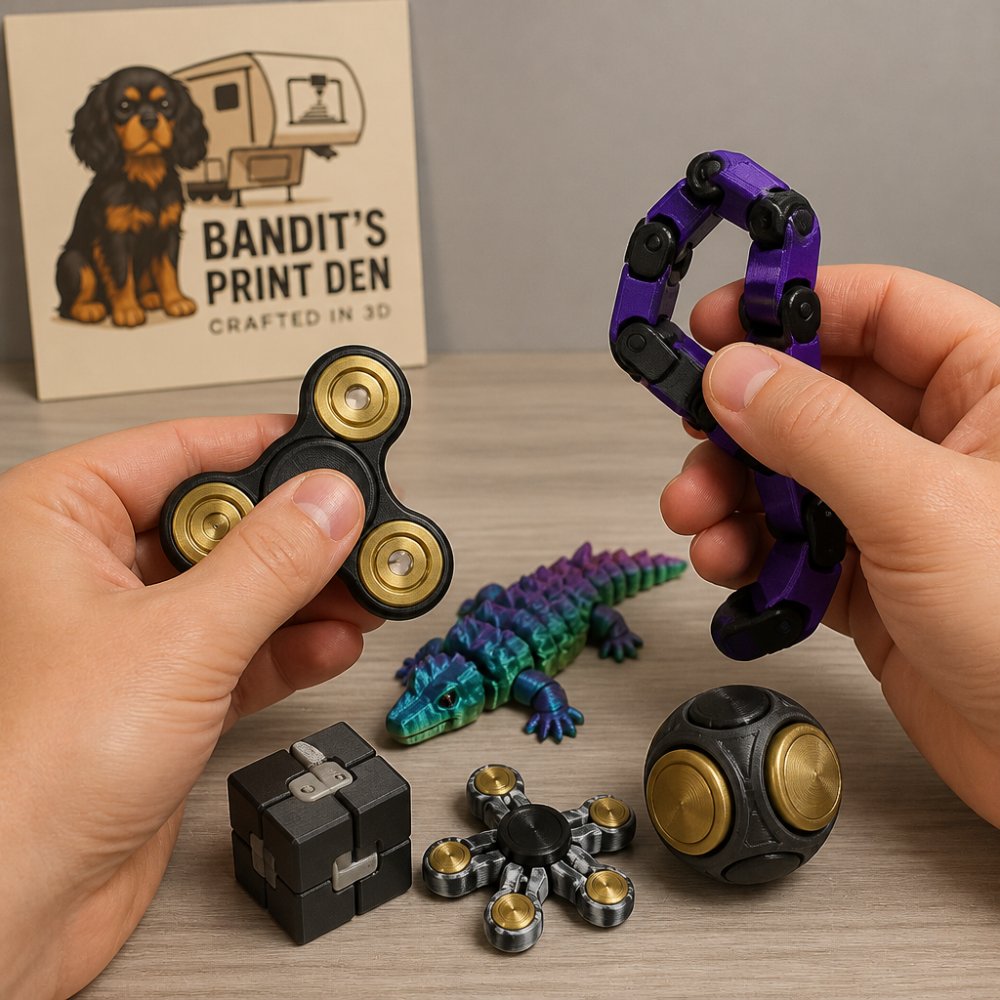
The cube's compact size makes it ideal for desk therapy or on-the-go practice. The Bandit's Choice color option ($5.00) offers the best value, while custom colors let users personalize their therapy tool.
SquishSpin 2" Textured Sensory Fidget Spinner: Tactile Feedback and Grip Comfort
The SquishSpin 2" Textured Sensory Fidget Spinner ($14.00) combines smooth spinning motion with tactile engagement. Its textured surface provides sensory stimulation while the two ball bearings deliver consistent, satisfying rotation.

The built-in finger placement guides users into proper grip position, and the textured surface prevents slipping during spins. This fidget works particularly well for users who benefit from sustained pressure practice, since spinning requires holding consistent finger position while the bearing does the work.
The 2-inch diameter fits comfortably in most hands without requiring excessive opening. Users can spin it with two fingers, three fingers, or a full hand grip, allowing progression as strength returns. The flexible rubber band adds another movement dimension, engaging hand flexibility alongside grip strength.
Mini Fidgets: Fully Articulated Pocket Companions for Dexterity Practice
The Mini Fidgets ($5.00 each, buy 4 get 1 free) represent the most sophisticated option for dexterity work. Each fully articulated creature demands independent finger control to pose and manipulate.
Infinity Cube Fidget Toy | 3D Printed Pocket Fidget →

These aren't passive fidgets but active engagement tools. Moving each limb separately requires finger isolation and motor planning. Collectors often purchase multiple designs.
The multicolor printing makes each piece unique, adding a collection element that encourages repeated engagement. Users often practice specific poses, and the "collectible" factor can transform therapy from obligation into hobby.
Flexi Manta Ray: Flexible Articulation for Hand Strengthening
The Flexi Manta Ray ($10.00) offers a different therapeutic angle. Its flexible wings and articulated body demand sustained hand pressure and controlled movement. Unlike clickers or spinners, the manta ray rewards strength development.
Flexing the wings requires hand muscles to work against material resistance, building grip strength and hand endurance. The 5-inch width accommodates various hand sizes and grip styles.
The rainbow coloring adds visual engagement, making therapy sessions feel less clinical. Users often find themselves creating movement patterns, making the manta "swim" or "dance". The satisfaction of smooth, controlled flexing provides immediate feedback on improving hand function.
Halloween Dumpling Clickers: Satisfying Clicking Mechanism for Finger Activation
The Halloween Dumpling Clickers ($36.00) deliver the most satisfying click mechanism available. The dumpling presses down into its base with a substantial, audible response that rewards each finger press.
Clickers are good for finger isolation practice. Each click requires pressing with specific fingers while keeping others relaxed. This builds independent finger control. The satisfying mechanical response creates positive reinforcement, users want to keep clicking because it feels good.
The keychain attachment keeps clickers accessible. Users attach them to keys, bags, or desk setups, turning everyday moments into therapy practice. The substantial size (2.75 inches) and weight provide tactile satisfaction that smaller fidgets can't match.
3D Printed Fidget Rings and Wearable Options for Continuous Therapy
Wearable fidgets, rings and finger-worn designs, offer a distinct advantage: they stay with you. Unlike desk fidgets requiring deliberate engagement, wearable fidgets integrate into daily life.
Fidget rings typically feature rotating bands, textured surfaces, or articulated segments. They work throughout the day: during meetings, while reading, or during commutes. This constant, low-intensity engagement maintains hand function without requiring dedicated therapy time.
The psychological benefit matters. Users don't feel like they're "doing therapy", they're simply fidgeting, a natural behavior. This removes the mental resistance that can derail therapy compliance. Occupational therapists increasingly recommend wearable fidgets specifically because patients actually use them consistently.
Ergonomic considerations apply even more to wearables. The ring must fit comfortably without restricting circulation. The rotating or articulated elements must move smoothly without requiring excessive finger pressure. A ring that's too tight, too stiff, or too loose becomes an irritant rather than a therapeutic tool.
American Occupational Therapy Association guidelines on wearable therapeutic devices
Safety, Material Quality, and Occupational Therapy Considerations
3D-printed fidgets demand attention to material safety and durability. PLA (polylactic acid) offers advantages: it's non-toxic, food-safe, and durable. However, quality varies significantly between manufacturers.
Poor-quality prints can develop weak points. Layer lines can become stress concentrations where joints fail. Inconsistent extrusion can create rough spots that irritate skin during extended use.
Bandit's Print Den addresses this through individual inspection by Bandit, the resident quality-control expert.
Hygiene considerations matter for shared therapy environments. PLA surfaces can be gently cleaned with mild soap and water. Fidgets should dry completely before storage to prevent moisture accumulation.
Size and choking hazard assessment applies especially to Mini Fidgets. The product description for Mini Fidgets recommends them for ages 3+ (contains small parts).
Material durability affects long-term therapy value. A fidget that degrades after weeks of use creates frustration and expense. Quality 3D printing using consistent PLA formulations produces durable fidgets. This durability justifies the investment.
Hand therapy requires engagement, not just motion. Ergonomic 3D printed fidgets for hand therapy bridge the gap between clinical obligation and genuine motivation.
Bandit's Print Den specializes in exactly this: high-quality, individually inspected 3D-printed fidgets designed for sustained engagement.
Frequently Asked Questions
Can 3D-printed fidgets actually be used for hand therapy?
Yes. Occupational therapists recognize fidgets as supplementary tools for hand rehabilitation, fine motor skill development, and stress reduction. Ergonomic 3D printed fidgets with articulated joints, textured surfaces, and smooth mechanisms provide tactile stimulation and repetitive motion that supports therapeutic goals. Always consult your occupational therapist before using any fidget as part of a formal rehabilitation program to ensure it matches your specific hand therapy needs.
What features make a fidget easier to hold with limited hand mobility?
Look for fidgets with ergonomic grip zones, textured surfaces for non-slip contact, and mechanisms that require minimal finger strength. Built-in finger placement guides and smooth-spinning or low-friction joints reduce strain. The SquishSpin 2" Textured Sensory Fidget Spinner ($14.00) features built-in finger placement and textured surfaces specifically designed for comfortable grip, making it suitable for users with reduced hand mobility.
How do articulated 3D-printed fidgets support hand rehabilitation?
Articulated designs with multiple moving joints engage different muscle groups and encourage varied hand movements. Flexing, rotating, and bending articulated sections builds dexterity, reduces stiffness, and provides sensory feedback. Products like the Flexi Manta Ray ($10.00) feature flexible articulated wings that create satisfying motion while promoting hand strengthening through gentle, repetitive manipulation.
Are 3D-printed fidgets safe for occupational therapy use?
Quality matters. Choose fidgets printed in food-safe, non-toxic PLA plastic from reputable makers who inspect each piece for sharp edges, loose parts, and layer defects. Check for age recommendations. Regularly inspect your fidget for cracks or wear, and clean it with a soft cloth.
0 comments