
Table of Contents
- Why the Material Choice Matters for 3D Figures
- PLA vs PETG for Articulated Figures: The Main Event
- When to Choose the Best Resin for 3D Printed Miniatures
- Step 1: Match the Material to Your Figure's Use
- Step 2: Post-Processing 3D Prints for Smooth Finishes
- Step 3: Weigh the Details: Joints, Weight, and UV Stability
- Quick Material Comparison for Your Next Figure
- Conclusion: Your Figure's Perfect Match
- Frequently Asked Questions
Last Updated: September 8, 2026
Why the Material Choice Matters for 3D Figures
The wrong material choice is the single biggest reason a 3D figure feels cheap, breaks at the joints, or warps on a sunny shelf. Choosing the best material for 3D figures comes down to balancing detail, durability, and finish. No single filament or resin wins every category.
Most buyers assume all 3D prints feel the same, but the differences between thermoplastics like PLA and PETG, or between filament and photopolymer resin, are dramatic. Below, we walk through the exact trade-offs so you can match the material to how your figure will actually be used.
PLA vs PETG for Articulated Figures: The Main Event
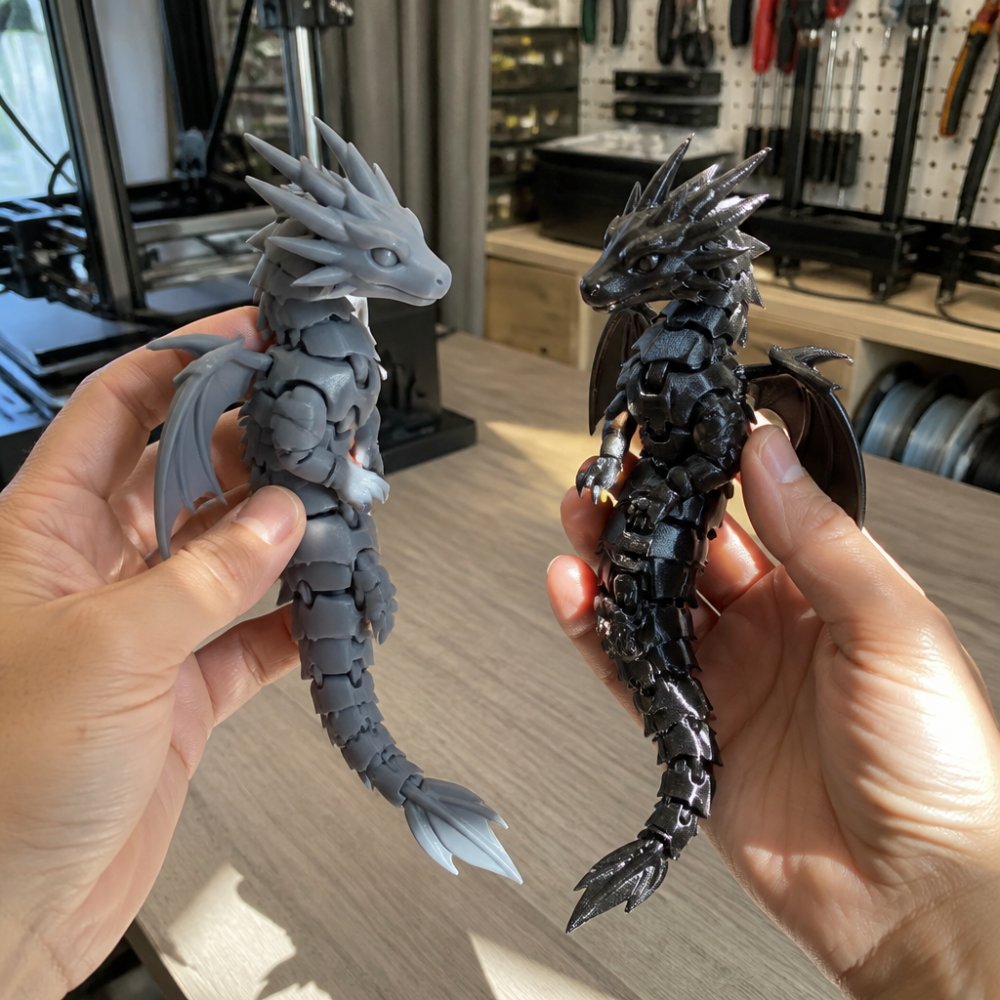
For articulated figures with moving joints, the choice almost always comes down to PLA versus PETG. PLA is the default for detailed display pieces because it holds sharp features and prints with excellent dimensional accuracy. PETG steps in when you need durability, flex, and resistance to wear for figures that get handled, fidgeted with, or posed repeatedly.
PLA: The Go-To for Detail and Ease
PLA is the best material for 3D figures when your priority is fine detail, sharp edges, and vibrant color. It prints at lower nozzle temperatures, which means less warping and better bed adhesion, and it produces a matte surface that takes paint beautifully. For display pieces like the Absolute Batman 3D Wall Display or the XXL Flexi T-Rex Skeleton, PLA delivers the crisp skeletal details and multicolor layering that make the piece pop.


The trade-off is durability. PLA has a lower glass transition temperature, so it softens in hot cars or direct sunlight, and it is more brittle than PETG under repeated stress.
PETG: When Durability Takes Priority
PETG becomes the best material for 3D figures when the piece needs to survive handling, travel, or outdoor conditions. It offers higher impact resistance and better flexural modulus than PLA, meaning joints bend rather than snap.
Our Glow-in-the-Dark Retractable Katana Toy is printed in PETG for exactly this reason. The telescoping blade sections need to slide and flex without cracking, and the material's durability makes that possible. If you're ordering an articulated piece that will be handled by kids, tossed in a bag, or used as a fidget, PETG is the safer bet.
When to Choose the Best Resin for 3D Printed Miniatures
Resin is the best material for 3D printed miniatures when you need ultra-fine surface detail and a smooth, layer-free finish. Unlike filament printing, which builds visible layer lines, resin printing cures a photopolymer liquid into solid form, capturing intricate textures and small features that filament cannot resolve.
The downsides are real. Resin prints are more brittle than PLA or PETG, so they are poor choices for articulated joints or anything handled roughly. Resin also requires post-curing under UV light and careful handling of the liquid resin itself.
Step 1: Match the Material to Your Figure's Use
Start by asking a simple question: will this figure be displayed, handled, or both? That answer narrows your options faster than any spec sheet.
- Pure display pieces (wall art, shelf statues): PLA or resin, depending on detail level
- Articulated figures that get posed: PLA for light posing, PETG for frequent handling
- Fidget toys and desk companions: PETG for durability, or PLA for the Infinity Cube Fidget Toy style pieces that live on a desk
- Outdoor or travel items: PETG for UV and moisture resistance
- Miniatures under 4 inches: resin for maximum detail
A common mistake is over-prioritizing one property, like strength, while ignoring weight and feel.
Step 2: Post-Processing 3D Prints for Smooth Finishes
Post-processing is where a figure transforms from a printed part into a collectible, and the material you choose dictates the entire finishing workflow.
Paint Adhesion by Material: What the Guides Don't Tell You
The chemical difference between PLA and PETG directly affects paint longevity. PLA is a polyester with a relatively porous surface after sanding, giving mechanical tooth for primer to grip. Acrylic primers bond well, and once sealed, PLA holds paint through moderate handling. PETG, by contrast, has a slicker, lower-surface-energy finish. Paint on unsanded PETG will bead up and peel within days. Even after sanding, PETG's surface resists mechanical adhesion, so it requires an etching primer or a wash with isopropyl alcohol before priming.
Resin sits at the opposite extreme. Fully cured resin prints have a dense, non-porous surface that rejects paint unless you first sand with fine grit (400+) or use a dedicated resin primer.
For articulated figures, paint adhesion matters at the joints. PLA joints that get posed repeatedly will wear through paint at the friction points within weeks. A common pattern among figure painters is to leave a 1-2 mm unpainted gap around ball-and-socket joints, or to apply a thin layer of clear gloss varnish to the joint surfaces before assembly.
The Sanding Sequence: Material-Specific Grit Paths
A generic "start at 120 and move to 400" approach fails with PETG. Here is the material-specific sequence that works in practice:
- PLA: Start at 120 grit for layer line removal, move to 220, then 320, then finish with 400 wet-sand. PLA sands dry without gumming, and you can achieve a near-injection-molded surface with patience. For a satin finish, stop at 320.
- PETG: Start at 180 grit and never go below that. Coarser grits tear PETG's surface rather than cut it, leaving deep gouges that are nearly impossible to remove. PETG also generates rubbery wisps during dry sanding; wet-sanding from the start prevents this. Finish at 400 for paint, or 600 if you plan to clear-coat without paint.
- Resin: Start at 400 grit because resin is soft enough that coarse grits leave permanent scratches. Move to 800, then 1200, and finish with a polishing compound if you want a gloss surface without paint. Resin dust is hazardous, so wet-sand or wear a respirator.
Chemical Smoothing: When It Works and When It Destroys Your Figure
Chemical smoothing is a legitimate shortcut for some materials, but it is dangerous for figures with fine detail. ABS responds to acetone vapor, which melts the outer layer and eliminates layer lines entirely. However, acetone vapor also rounds off sharp edges, welds articulated joints together, and can distort thin features. For an articulated figure, avoid it entirely.
PLA has no safe chemical smoothing agent. Solvents like dichloromethane will dissolve PLA, but they are toxic and difficult to control. PETG is resistant to most common solvents, which means chemical smoothing is not an option. Resin prints can be smoothed with isopropyl alcohol before curing, but only during the brief window after printing and before the final UV cure.
Priming, Painting, and Sealing for Figure Longevity
For figures that will be displayed, the finishing stack matters as much as the material:
- Sand to the appropriate grit for your material (see above)
- Clean the surface with isopropyl alcohol to remove dust and oils
- Apply a filler primer in thin coats, 2-3 passes, allowing each to dry
- Wet-sand the primer at 600 grit to knock down any remaining texture
- Paint with acrylics formulated for plastic models; thin coats with 15-20 minutes between layers
- Seal with a matte or satin clear coat for display, or a gloss coat for handled figures
- For articulated joints, mask the joint surfaces before sealing to avoid paint locking the joint
Step 3: Weigh the Details: Joints, Weight, and UV Stability
Three factors separate a figure that survives years of posing from one that ends up in a drawer: joint wear mechanics, weight distribution, and long-term UV degradation.
Joint Wear and Friction Coefficients: The Articulation Killer
Articulated figures rely on ball-and-socket or hinge joints that experience repeated friction. The material's coefficient of friction determines how smoothly the joint moves and how quickly it wears.
PLA has a relatively high coefficient of friction against itself. PLA-on-PLA joints start tight, then grind down as the softer surface sheds microscopic particles. After 500-1,000 pose cycles, a PLA ball joint can become loose and sloppy.
PETG has a lower coefficient of friction and a slightly softer, more compliant surface. PETG-on-PETG joints wear more slowly because the material deforms elastically under load rather than shearing off particles. A PETG ball joint can survive 5,000+ pose cycles before noticeable loosening.
Resin is the worst choice for moving joints. Cured resin is brittle and has a high coefficient of friction, so resin-on-resin joints either bind immediately or crack at the socket within a few dozen poses.
For figures that will be posed heavily, a hybrid approach works best: print the joint pegs and sockets in PETG for wear resistance, and print the visible body panels in PLA for detail and paintability.
Weight, Density, and Center of Gravity
Material density directly affects how a figure feels in hand and whether it stays upright. PLA has a density of approximately 1.24 g/cm³, PETG is about 1.27 g/cm³, and standard resin ranges from 1.10 to 1.20 g/cm³ depending on the formulation. These differences seem small, but for a large figure, they add up. A 10-inch solid PLA figure weighs roughly 20-25% more than the same figure in resin.
Center of gravity is the engineering problem that material choice alone cannot solve. A figure with a large head, heavy weapon, or dramatic pose will tip forward regardless of material. The fix is base weighting, and the material choice determines how you do it:
- PLA and PETG: Both are dense enough that a solid, wide base can stabilize most figures. For top-heavy designs, increase the base wall thickness to 3-4 mm or add a hollow cavity in the base that you fill with steel shot or lead shot before sealing. A 1-inch diameter cavity filled with lead shot adds roughly 50 grams of stabilizing weight.
- Resin: Resin figures are lighter than filament figures at the same volume, so they are more prone to tipping. Professional resin studios often cast a metal disc into the base during the curing process. A 2-inch diameter, 1/8-inch thick steel disc adds about 40 grams and drops the center of gravity significantly.
A practical rule for articulated figures: if the figure stands on two legs and has arms raised above shoulder height, it will tip backward or forward unless the base extends at least 1.5 times the figure's foot length in the direction of the lean.
Thermal Resistance: The Numbers Behind the Warning
UV stability and heat resistance are often conflated, but they are separate failure modes. PLA has a glass transition temperature (Tg) of approximately 60°C (140°F). This is the temperature at which the material begins to soften and deform under load. A car dashboard on a summer day can exceed 70°C (158°F), which is why PLA figures left in vehicles warp within hours.
PETG has a Tg of approximately 80°C (176°F), which gives it a meaningful safety margin for indoor display near windows. Resin has a heat deflection temperature that varies wildly by formulation; standard resins soften around 50-60°C (122-140°F), while high-temperature engineering resins can withstand 150°C+ (302°F+). For display figures, standard resin is actually the least heat-tolerant option.
UV Degradation: The Slow Fade
UV exposure causes two distinct problems: color fading and embrittlement. PLA contains colorants that break down under UV light, causing fading within 6-12 months of direct sun exposure. More critically, UV radiation breaks the polymer chains in PLA, making the material progressively more brittle.
PETG has better UV resistance because the glycol modification reduces chain scission under UV light. However, PETG is not UV-stable indefinitely; it will yellow slightly over 2-3 years of direct sun exposure. Resin is the most variable: standard resins yellow and become brittle within months under UV light.
The Practical Decision Matrix for Figure Makers
When you combine joint wear, weight, and UV stability, the decision framework becomes clear:
- Display-only figure, no direct sun, no handling: PLA or resin, depending on detail level
- Display figure near a window: PETG for UV stability, or PLA with a UV-protective clear coat
- Articulated figure posed weekly: PETG for joints, PLA for cosmetic panels if you want paintability
- Figure that travels in a bag or car: PETG only; PLA will not survive thermal cycling
- Miniature with moving parts: Resin body with embedded metal pins, or switch to PETG for the moving elements
Quick Material Comparison for Your Next Figure
| Material | Best For | Durability | Surface Finish | Paintability | UV Stability |
|---|---|---|---|---|---|
| PLA | Display pieces, detailed figures | Moderate, brittle under stress | Matte, visible layer lines | Excellent | Poor |
| PETG | Articulated, handled figures | High, flexes under stress | Slight gloss | Moderate | Good |
| Resin | Miniatures, micro-detail | Low, brittle | Ultra-smooth, no layers | Excellent | Moderate |
The table above summarizes the key trade-offs, but the real answer depends on your specific figure. For a display-grade articulated dragon like the Axolotl Dragon, PLA delivers the crisp scales and dual-color finish that make it pop.

Conclusion: Your Figure's Perfect Match
Choosing the best material for 3D figures is not about finding one perfect option, it is about matching the material to how the figure lives. PLA wins for detailed display pieces with vibrant colors and easy paintability. PETG wins for anything that gets handled, posed, or taken outdoors. Resin wins for miniature-scale detail that filament cannot match. When you order from Bandit's Print Den, every piece is printed, inspected, and finished in-house, so you get the right material for your figure without the guesswork. Browse our articulated collectibles or start a custom order.
Frequently Asked Questions
What is the best material for 3D printing figures?
PLA is the best all-around material for most 3D-printed figures, especially display pieces and articulated desk buddies. It prints easily, captures fine details well, and is available in many colors. If your figure will be handled often or spend time in a warm car, PETG is the better choice for its durability and heat resistance.
Is PLA or PETG better for figurines?
For static figurines focused on detail, PLA is usually better because it's easier to print with sharp corners and smooth surfaces. For articulated figures with moving joints that need to withstand repeated posing, PETG is tougher and less likely to snap at thin connection points. Consider how much play and movement your figure will endure.
Does resin or filament produce better detail for 3D figures?
Resin 3D printers produce significantly finer detail than filament printers, making resin the best choice for highly detailed miniatures with intricate features. However, resin prints are brittle and require post-curing. Filament prints are more durable and ideal for articulated figures that need to bend and flex.
How do I choose between PLA, ABS, and Resin for display pieces?
For a display piece that stays on a shelf, PLA is often the best choice due to its ease of printing and excellent detail. ABS offers higher heat resistance but is prone to warping and fumes, making it less ideal for detailed figures. Resin provides the highest detail but is brittle and requires more post-processing. Your choice depends on the level of detail needed versus the durability required.
0 comments