
Table of Contents
- What Separates Collector-Grade Articulated Figures in 2026
- Quick Comparison: Best Articulated Figures for Collectors 2026
- XXL Flexi T-Rex Skeleton: The Statement Centerpiece
- T-Rex Dinosaur (2 Sizes): Best Entry Point for New Collectors
- Axolotl Dragon and Mistletoe Dragon: Long-Form Poseability
- Bandit's Buddies: The Only Articulated Figure With an Adoption Kit
- Iguana, Wendigo, and Seasonal Dragons: Niche Picks Worth Displaying
- Custom 3D Printed Articulated Figures: What Actually Gets Made
- Articulated Figure Posing Guide: Shelf Presence and Dynamic Poses
- Collectible Figure Maintenance Tips: Keeping Joints Tight
- Counterfeit Identification: Spotting a Fake Articulated Figure
- Environmental Impact: What PLA Means for Collectors
- Frequently Asked Questions
Last Updated: September 12, 2026
What Separates Collector-Grade Articulated Figures in 2026
The best articulated figures for collectors in 2026 aren't judged by brand name or shelf price alone. They're judged by joint tension, sculpt accuracy, paint application, and how well a figure holds a pose months after you unbox it. At Bandit's Print Den, we print and hand-finish articulated figures, so we've learned exactly where cheap prints fail and where quality shows.
A collector-grade articulated figure is a poseable model built from interconnected joints that let the body, limbs, head, or tail move independently while staying in position. The difference between a novelty flexi and a display piece comes down to three things: how the joints are engineered, how clean the finish is, and whether the figure actually stands up to repeated posing.
Most buyers focus on size. Experienced collectors focus on tension and stability. A figure with loose joints collapses the moment you set it down; one with uneven tension fights every pose you try. That's the real dividing line in 2026.
Joint Engineering and Range of Motion
Joint engineering determines whether a figure poses or flops. Look for consistent tension across every articulation point, a full range of motion without binding, and joints that hold position under their own weight.
The technical markers worth checking:
- Articulation points: Count them. More points mean more poseability, but only if each joint moves independently.
- Joint tension: Test whether limbs hold a pose or drift. Even tension across all joints signals a well-tuned print.
- Range of motion: Rotating heads, hinged jaws, and segmented tails add display options.
- Figure stability: A figure that stands on its own without a display base is engineered correctly.
A common mistake is assuming more joints always means better. A figure with fifteen loose joints poses worse than one with eight tight ones.
Sculpt Accuracy, Paint Application, and Finish
Sculpt accuracy is how faithfully a figure's anatomy, texture, and detail match the intended design. Paint application and premium finish decide whether it looks collector-grade or homemade.
For 3D-printed figures, "paint" usually means color-matched filament rather than applied paint. That matters because filament color won't chip or transfer the way painted surfaces can. Watch for:
- Molding detail: Crisp scales, teeth, claws, and skeletal elements
- Paint transfer: Color bleeding between adjacent parts
- Premium finish: Even surfaces without heavy layer lines
The honest trade-off: no 3D-printed figure is perfectly smooth. Minor layer lines and slight surface variation are normal, not defects. What separates good from bad is whether those marks are subtle or distracting.
Quick Comparison: Best Articulated Figures for Collectors 2026
Here's how the top picks stack up on size, price, and best use. Every figure below is printed and finished by Bandit's Print Den.
| Figure | Size | Price | Best For |
|---|---|---|---|
| XXL Flexi T-Rex Skeleton | 36" long, 20" tall | $220.00 | Statement centerpiece |
| T-Rex Dinosaur (2 sizes) | 9.5" or 15.5" long | $13.00 | Entry point for new collectors |
| Axolotl Dragon | 25"-28" long | $14.00 | Long-form poseability |
| Bandit's Buddies | 4"+ long | $16.50 | Gifts with an adoption kit |
| Iguana | 12" long | $30.00 | Niche reptile display |
| Wendigo | 7.25" tall | $15.00 | Fantasy collectors |
| Mistletoe Dragon | 12" long | $20.00 | Seasonal display |
This price-to-value ratio spread covers a range of budgets, from a first flexi to a three-foot centerpiece.

XXL Flexi T-Rex Skeleton: The Statement Centerpiece
If shelf presence is the goal, nothing here touches the XXL Flexi T-Rex Skeleton. At roughly 36 inches long and 20 inches tall, it's a freestanding display piece that dominates a game room, office, or classroom shelf.
The open skeletal construction shows detail throughout the skull, teeth, rib cage, spine, and sweeping tail. Oak and Bone White PLA contrast to make individual bones, claws, and vertebrae stand out, with a black eye detail adding personality. The oversized skull has a hinged jaw that opens and closes, and the segmented spine and tail flex and curve for dynamic posing.
Where it falls short: it needs serious room. At three feet long, it won't fit a standard desk shelf, and that's the honest limitation most buyers underestimate.
Price: $220.00. Bandit's Print Den XXL Flexi T-Rex Skeleton
T-Rex Dinosaur (2 Sizes): Best Entry Point for New Collectors
New to collecting articulated figures? Start with the T-Rex Dinosaur. At $13.00, it delivers the same articulation and personality as larger pieces without the commitment.

It comes in two sizes: a compact 9.5-inch Small and an impressive 15.5-inch Large. Both feature a Summer Green gradient body, white teeth, a red tongue, and expressive eyes. The tail, legs, and arms articulate, and the movable jaw opens and closes to change its expression.
Because gradient filament shifts color as it prints, no two T-Rexes look identical. That's a genuine plus for collectors who want a unique piece.
Price: $13.00. Bandit's Print Den T-Rex Dinosaur
Axolotl Dragon and Mistletoe Dragon: Long-Form Poseability
Long figures pose better, and two dragons here prove it. The Axolotl Dragon runs 25 to 28 inches, pairing axolotl frills with a flowing dragon body in dual-color PLA. The Mistletoe Dragon measures 12 inches in green, red, and white.

Both bend, curl, and hold a pose thanks to interconnected articulated sections. The Axolotl Dragon's extra length makes it a great choice for dramatic curls and wraps; the Mistletoe Dragon's 12-inch frame suits holiday displays and gift baskets.
Price: Axolotl Dragon $14.00, Mistletoe Dragon $20.00.
Bandit's Buddies: The Only Articulated Figure With an Adoption Kit
Bandit's Buddies is the one entry here that's as much a gift experience as a figure. Each fully articulated companion dog arrives with an adoption kit: a breed profile card, an official adoption certificate on parchment-style paper with a wax seal, and a document holder to keep it all safe.
At 4 inches or more in length with fully poseable joints, each Buddy works as a desk companion, shelf piece, or emotional support desk pet. No two adoptions are identical, since every dog is individually printed and hand-prepared.
Where it falls short: at 4 inches, it's smaller than the dragons and won't anchor a large display. It's built for desks and gifting, not centerpieces.
Price: $16.50. Bandit's Print Den Bandit's Buddies
Iguana, Wendigo, and Seasonal Dragons: Niche Picks Worth Displaying
Niche collectors get the best options here. The Iguana is a 12-inch, four-color flexi reptile with a rotating head and poseable body, legs, and tail. The Wendigo stands 7.25 inches tall with a skeletal antlered head, clawed limbs, and a rotating head in dual-color red and black silk PLA.
Seasonal dragons round out the niche tier: the Pumpkin Dragon at 8.75 inches, the Heart Dragon at 6.5 inches, and the Fireworks Dragon at 4.75 inches. Each is fully articulated and priced to collect in multiples.
The thing nobody tells you about seasonal figures: buy them when you see them. Seasonal colorways don't always return, and collectors who wait often can't find the piece later.
Price: Iguana $30.00, Wendigo $15.00, seasonal dragons $10.00 each.
Custom 3D Printed Articulated Figures: What Actually Gets Made
Custom work is where articulated figures get personal. Instead of choosing from a catalog, you describe what you want and Bandit's Print Den prints it, whether that's a specific creature, a color match, or a one-off desk piece.
Three things to know before ordering custom:
- You don't need design files. Describe the figure and the colorway, and the studio handles the rest.
- Custom prints take longer than in-stock items. Plan around any deadline and ask about timing up front.
- Custom means unique. No one else gets the same figure.
The mobile fifth-wheel workshop setup is simply where the printing happens. Standard orders ship fast, and free shipping applies on orders over $35.
Articulated Figure Posing Guide: Shelf Presence and Dynamic Poses
Good posing is what turns a figure into a display piece. The best articulated figures for collectors in 2026 are only as impressive as the pose you put them in, so here's how to get shelf presence right.
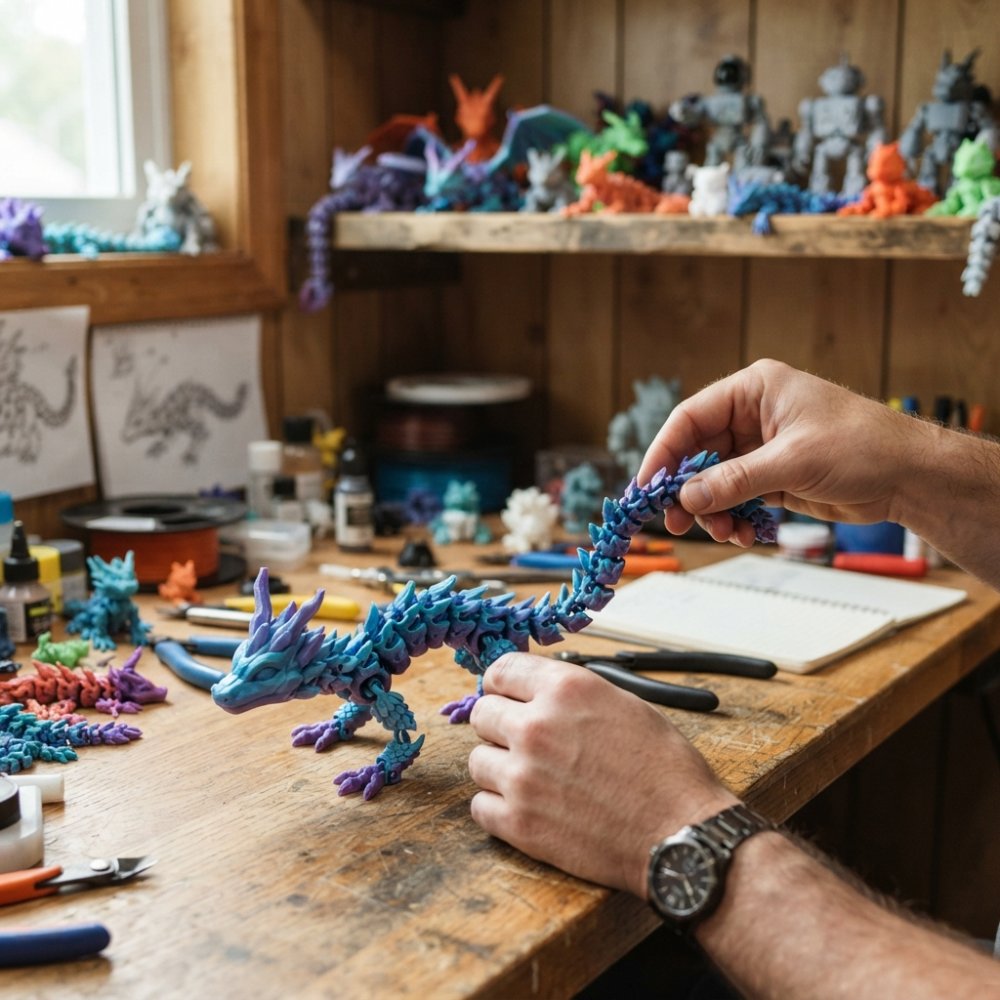
Start with the base. Set the feet or tail flat, then adjust the spine into a gentle curve. For dynamic posing, offset the head and tail in opposite directions to suggest motion. Rotate the head slightly off-axis; a straight-on head reads as static.
For a full range of motion, work joints one at a time and stop before you feel resistance.
Collectible Figure Maintenance Tips: Keeping Joints Tight
Maintenance is the gap most collectors ignore until a joint goes loose. A few habits keep articulated figures posing for years.
- Dust with a soft brush, not a cloth. Cloth catches on articulated segments and can snap thin joints.
- Store figures out of direct sunlight. UV exposure fades filament color over time.
- Pose gently and infrequently. Repeatedly forcing the same joint wears its tension.
- Keep figures away from heat. PLA softens in high heat, which can warp thin articulated parts.
- Handle by the body, not the tail tip. The tail is the most fragile joint on long figures.
For a loose joint, avoid glue. It locks the joint permanently and ruins poseability. Instead, reduce how often you move that joint and keep the figure in a stable pose.
Counterfeit Identification: Spotting a Fake Articulated Figure
Counterfeits are a real problem in the articulated figure market, and spotting one protects your investment. A genuine collector-grade print shows consistent joint tension, clean color transitions, and no chemical smell.
Check these markers:
- Joint tension: Fakes often have uneven or loose joints across the figure.
- Finish: Sharp layer lines and rough surfaces signal a rushed print.
- Color: Gradient and dual-color effects should transition smoothly, not in harsh bands.
- Weight: Cheap prints feel light and hollow for their size.
- Source: Buy from the maker or an authorized seller with a real product page.
A visual checklist beats a gut feeling. If two or three markers look wrong, walk away.
Environmental Impact: What PLA Means for Collectors
PLA, the material behind nearly every figure here, is a plant-based filament made from renewable resources like corn starch. It's the most common filament for articulated prints because it holds detail well and is widely recyclable in industrial composting facilities.
That doesn't make it zero-impact. PLA still requires energy to produce and print, and most curbside programs won't accept it. The practical takeaway for collectors: buy fewer, better figures, keep them out of the trash, and check local composting options before discarding a print.
The good news is that articulated figures are built to last. A well-maintained print outlives the novelty toys it replaces, which is the most sustainable choice of all.
Frequently Asked Questions
How does 3D printing compare to mass-produced articulated figures?
3D-printed articulated figures print joints already assembled, which means no glue and no assembly, but each print can vary slightly in joint tension. Bandit's Print Den notes minor layer lines and small differences in joint fit between prints are normal. The trade-off is design freedom: you can get a 36-inch articulated T-Rex skeleton that no mainstream toy line would tool up for.
Which articulated figure has the best range of motion?
Range of motion depends on how many articulation points a design carries. The Axolotl Dragon bends and curls along its entire 25 to 28 inch body, making it the most flexible piece in this lineup. The XXL Flexi T-Rex Skeleton adds a hinged jaw on top of an articulated spine, limbs, and tail. The Wendigo pairs articulating arms, legs, and tail with a rotating head. If you want maximum poseability, prioritize designs with segmented spines rather than figures with only limb joints.
Are articulated 3D-printed figures durable enough for display?
Yes, with care. These figures print in PLA, which holds shape well at room temperature but softens in high heat. Joints are the fragile points: move them slowly. Store larger pieces like the 36-inch T-Rex on a stable surface where it will not get knocked over. Handled normally, a printed figure holds up for years of shelf duty.
What collectible figures will be most sought after in 2026?
Limited and seasonal runs tend to hold collector interest longest. Seasonal pieces like the Pumpkin Dragon, Heart Dragon, and Mistletoe Dragon only print for part of the year, which makes them harder to find later. Large statement pieces such as the XXL Flexi T-Rex Skeleton also draw attention because of the material and print time involved. Bandit's Buddies stands out for a different reason: each adoption ships with a companion profile card and a wax-sealed certificate, which gives it documentation most printed figures never have.
How do I keep articulated joints from loosening over time?
Handle joints less and pose them deliberately. Repeated wiggling wears down the friction fit that holds a pose, so set a pose and leave it. Keep figures away from heat, since warm PLA relaxes and joints lose tension. For display, use a stable base or stand rather than balancing a large piece on its feet.
0 comments