
Table of Contents
- Why Resin Type Matters for Articulated 3D Prints
- Standard Resin vs. Tough Resin for 3D Printing
- Flexible Resin for 3D Printing: When and Why to Use It
- Resin vs. Filament for Articulated Figures: Which Wins
- Resin 3D Printing Articulated Joints: Design and Material Strategy
- Quick Comparison Table: Resin Types for Articulated Prints
- Common Mistakes to Avoid When Choosing Resin for Articulated Prints
- Frequently Asked Questions
Last Updated: October 12, 2026
Why Resin Type Matters for Articulated 3D Prints
When you're printing articulated figures, dinosaurs, dragons, or any creature with moving joints, resin choice determines whether your print survives its first pose or snaps apart after a week on your desk. The material you select controls how much stress those joints can handle, how flexible the connections are, and whether the piece feels cheap or premium in your hand.
Standard resin gets you fine details and smooth surfaces. Tough resin handles repeated movement without cracking. Flexible resin lets joints bend and move like actual creatures. Each type has a completely different job, and picking the wrong one for your project wastes money and leaves you frustrated.
The single biggest mistake we see is people choosing resin based on price or color alone, ignoring how the material actually behaves under stress. A beautiful flexible dragon that snaps at the hip joint after three days of posing is worse than a tougher option that looks slightly less detailed.
This guide covers the best resin types for articulated 3D prints, how to match materials to your specific use case, and the design choices that make joints actually work. We'll walk through the trade-offs between standard, tough, and flexible resins, and give you a clear framework for choosing the right material the first time.
Standard Resin vs. Tough Resin for 3D Printing
Standard resin delivers crisp details and smooth surfaces. It's the default choice for most 3D printing, and for good reason: it cures fast, captures fine features, and costs less than specialty resins. But here's the catch: standard resin is brittle. Bend an articulated joint too far or drop a standard resin print, and you'll hear a snap.
Tough resin is formulated to absorb impact and flex under stress without breaking. It's thicker, prints slightly slower, and costs more. The trade-off is worth it for any articulated print that will see repeated movement or handling.
The mechanical difference is real. Standard resin typically breaks under sudden stress. Tough resin bends first, absorbs the impact, and springs back. For articulated prints, this difference between snapping and surviving is everything.
Flexible Resin for 3D Printing: When and Why to Use It
Flexible resin is a completely different category. Instead of being rigid or tough, it's designed to bend and move without permanently deforming. It's the closest thing 3D printing has to rubber or silicone.
The downside is real: flexible resin sacrifices detail sharpness. You'll see softer edges, less crisp features, and a slightly matte finish compared to standard resin. It's also the most expensive option and requires careful handling during printing and post-processing.
Many people assume flexible resin is the answer for all articulated prints. It's not. If your figure has thin, detailed parts (like dragon horns, spikes, or fine claws), flexible resin can feel mushy and lack definition. The material is too forgiving, it absorbs the precision that makes articulated figures look good.
The real win for flexible resin is when the entire design is built around movement. A manta ray fidget toy with articulated wings needs flexible resin to deliver that satisfying flex. A detailed dragon with thin horns and fine scales does better with tough resin, which keeps the details sharp while still surviving joint movement.
Resin vs. Filament for Articulated Figures: Which Wins
This is where the comparison gets interesting. Filament (like PLA or ABS) is cheaper, more accessible, and works in any FDM 3D printer. So why would anyone choose resin for articulated figures?
The answer is detail and surface quality. Filament prints need post-processing to look polished, sanding, priming, painting. For articulated figures where the joints need to fit precisely and move smoothly, resin wins on accuracy and finish.

Filament is also more durable in some ways. PLA is tougher than standard resin and less brittle. You can print articulated figures in flexible filament too, which bends without breaking. The catch is that filament prints have visible layer lines, rougher surfaces, and less dimensional accuracy. Joints that should be tight fit loose. Details blur together.
For collectors and gift-buyers, articulated figures look and feel significantly better. The surface finish is superior, the details are sharper, and the overall quality is noticeably higher. If you're paying for a custom articulated figure, resin is what separates a premium piece from a novelty toy.
Filament wins on:
- Cost (significantly cheaper)
- Durability in some materials (flexible filament is genuinely flexible)
- Accessibility (works with common FDM printers)
- No need for specialized post-processing equipment
For articulated figures specifically, the precision matters for joints, and the finish matters for display quality.
Resin 3D Printing Articulated Joints: Design and Material Strategy
Here's where material choice meets actual engineering. Articulated joints work or fail based on three things: the joint design, and the clearance between moving parts.
Tight joints will snap. The stress concentrates at the connection point, and the brittle material fails under repeated movement. Tough resin with the same tight joint will hold up longer but still eventually fatigue. Flexible resin with tight joints will bind, the parts won't move smoothly because there's no room for the material to flex.
XXL Flexi T-Rex Skeleton | 36" 3D Printed Articulated Dinosaur →
The real strategy is matching material type to joint design. Tight, precisely-fitting joints work best with tough materials, which are stiff enough to maintain the fit while being strong enough to handle stress. Loose, freely-moving joints work with flexible materials, which can absorb the movement without binding.
Joint clearance matters more than most people realize. A joint that's too tight will bind and refuse to move smoothly. A joint that's too loose will feel sloppy and cheap. The sweet spot depends on the resin type and how the joint is oriented during printing.
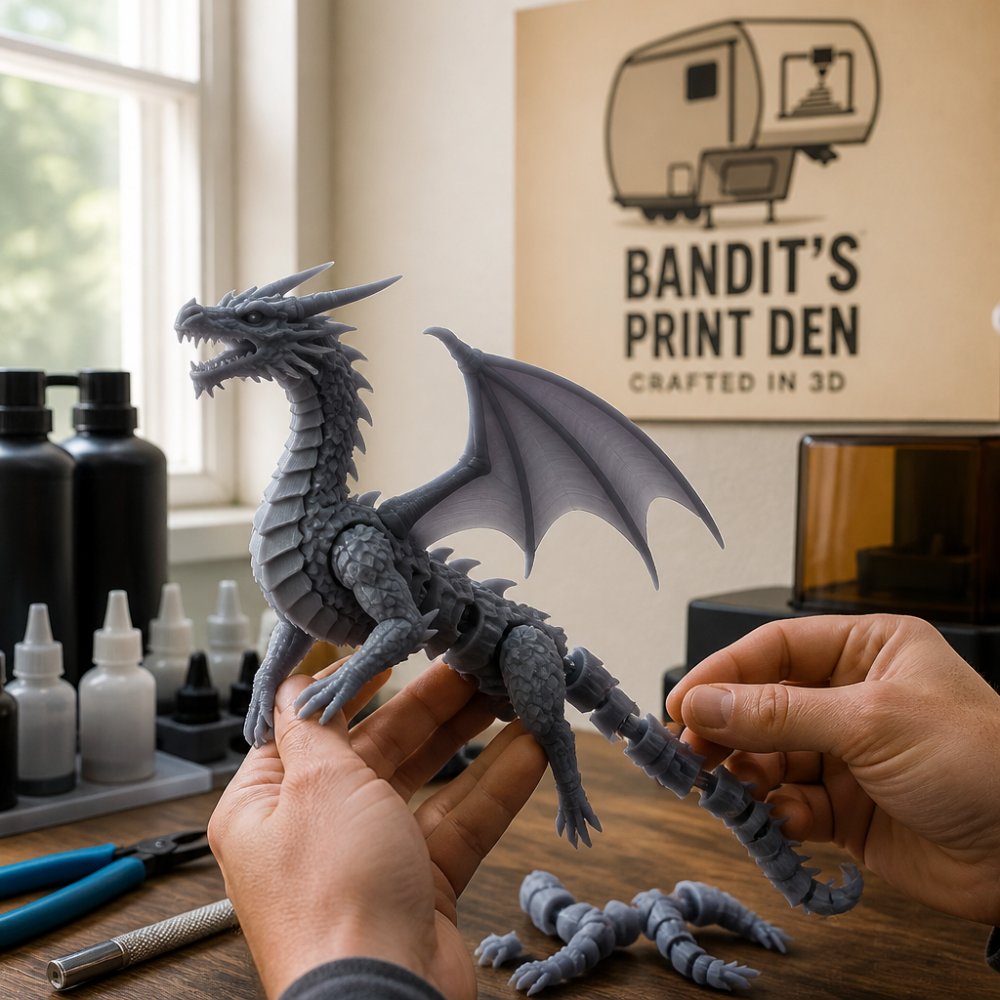
Post-curing affects how joints perform. Under-cured resin stays slightly flexible and sticky. Over-cured resin becomes harder and more brittle. The right cure time for tough resin produces joints that move smoothly without feeling loose. Under-cure flexible resin and it never fully sets. Over-cure it and it loses its elasticity.
Many articulated prints fail because the design doesn't account for how material actually behaves. A joint that looks perfect on screen prints with internal stresses, micro-cracks, and weak points that show up only after repeated movement. The fix is designing joints with material properties in mind, understanding that tough materials are stiffer than flexible materials, that thin sections cure differently than thick sections, and that orientation during printing affects final strength.
Quick Comparison Table: Resin Types for Articulated Prints
| Resin Type | Best For | Joint Movement | Detail Sharpness | Durability | Relative Cost |
|---|---|---|---|---|---|
| Standard Resin | Static display pieces, high detail | Limited (brittle) | Excellent | Poor under stress | Low |
| Tough Resin | Articulated figures with repeated movement | Good (handles stress) | Very good | Excellent | Medium |
| Flexible Resin | Fidget toys, high-flex designs | Excellent (bends freely) | Fair (softer edges) | Excellent for flex | High |
The table shows the core trade-off: detail sharpness versus durability under movement. Standard resin gives you the sharpest details but fails quickly. Tough resin balances both. Flexible resin sacrifices detail for endless flexibility.
Common Mistakes to Avoid When Choosing Resin for Articulated Prints
Mistake 1: Choosing material based on color alone. A beautiful blue standard material looks great for exactly one day. Then the first joint snaps. Material properties matter infinitely more than color.
Mistake 2: Assuming flexible material is the answer for all articulated prints. Flexible material is expensive and sacrifices detail. It's perfect for fidget toys and pure-movement designs. For articulated figures with intricate details, tough material is the better choice.
Mistake 3: Under-estimating joint stress. A small dragon that looks delicate can survive hundreds of pose changes if the joints are designed and printed correctly. Conversely, a sturdy-looking figure with tight joints will snap if printed in standard resin. Don't judge durability by appearance.
Mistake 4: Ignoring post-processing effects. How you wash, cure, and handle the print after it comes off the build plate affects joint performance. Over-curing makes material brittle. Under-curing leaves it sticky and weak. The right cure time for your specific material matters.
Mistake 5: Printing articulated figures in standard material and expecting them to last. This is the most common mistake we see. People print beautiful standard material figures, pose them once for photos, and then the joints fail under normal handling.
Mistake 6: Not testing your design. Print a single articulated segment in your chosen material before printing the full figure. Move it repeatedly. Drop it. Stress-test it. If it fails in the test phase, your full figure will fail the same way.
When you're ready to order articulated figures that actually survive repeated movement, Bandit's Print Den specializes in exactly this problem. Our [articulated dinosaurs like the T-Rex Dinosaur available in two sizes](https://banditsprintden.com/products/t-rex-dino-jackson-ff-fm) are printed in PLA specifically because the joints need to survive posing and handling. The Fully Articulated Iguana uses the same approach, material choice matched to the design demands of the figure.

Choosing the best material types for articulated 3D prints means understanding the real differences between standard, tough, and flexible materials, then matching those properties to how your figure will actually be used. Standard material is beautiful but brittle. Tough material balances detail and durability.
At Bandit's Print Den, we build articulated figures designed to move, pose, and survive daily handling. Free shipping on orders over $35 means you can start with a smaller piece like the Flexi Manta Ray and experience the difference quality printing makes.

Frequently Asked Questions
What resin is best for articulated 3D prints?
The best material depends on your joint type and movement intensity. Tough materials handle repeated stress and high-impact joints well, resisting snapping and fatigue. Flexible materials work for joints that need constant bending without cracking. Standard materials suit display pieces with minimal movement. Consider your articulation design, high-stress joints benefit from tough materials, while flowing joints like dragon tails work well with flexible materials. Proper clearance between joint parts matters as much as material choice.
Can flexible resin for 3D printing handle articulated joints that move repeatedly?
Yes, flexible materials excel at repeated movement. Their elasticity absorbs stress without fracturing, making them ideal for joints that bend, twist, or flex constantly. However, they sacrifice some impact resistance, if a joint experiences sudden shocks or drops, flexible materials may deform more than tough materials. For articulated figures like action figures or fidget toys that see frequent handling, flexible materials are often the better choice. Ensure adequate clearance between joint parts to prevent binding.
How much clearance do resin-printed articulated joints need?
Most articulated joints need 0.3-0.5 mm clearance between moving parts to prevent binding and allow smooth motion. Larger joints can tolerate 0.5-1 mm. Too little clearance causes friction and wear; too much creates loose, unsatisfying movement. Test clearance on your first print and adjust your print settings or print orientation if joints feel tight.
Is tough resin better than flexible resin for articulated figures?
It depends on your use case. Tough materials are better for high-stress joints, miniature details, and figures that experience impact or rough handling. They resist snapping and maintain their shape under repeated stress. Flexible materials are better for flowing designs, constant bending motion, and figures that prioritize smooth articulation over impact resistance. Many collectors use tough materials for display figures and flexible materials for fidget toys or figures meant to be posed frequently.
Do resin-printed articulated parts need post-curing, and does it affect joint movement?
Yes, post-processing can harden materials and improve mechanical strength, reducing brittleness and improving fatigue resistance. However, over-processing can make joints slightly stiffer. Properly processed joints move smoothly without sacrifice. Let prints cool before handling articulated joints to avoid warping from heat.
0 comments