

Table of Contents
- Why Durable 3D Printed Desk Accessories Matter
- Best Filament for Functional Desk Prints
- 7 Durable 3D Printed Desk Accessories That Organize Your Workspace
- How to Finish 3D Prints for Durability
- 3D Printed Desk Organization Ideas for Maximum Workspace Productivity
- Customization and Personalization for Your Workspace
- Maintenance and Cleaning Guides for Long-Lasting Accessories
- Conclusion
Last Updated: August 27, 2026
Why Durable 3D Printed Desk Accessories Matter
Your desk is where you spend eight hours a day. Most office organizers are mass-produced plastic that breaks within months. Durable 3D printed desk accessories solve that problem because they're built to last, customizable to your exact needs, and more interesting than generic alternatives.
The real advantage is that 3D printing lets you design accessories that fit YOUR workspace, not some generic template. A cable management solution that matches your desk dimensions. A pen holder sized exactly for your favorite pens. A modular shelving system that grows with your needs. But not all 3D prints are created equal. Layer lines, warping, and brittle failure points are real problems if you don't understand materials and design. This guide covers the seven desk accessories that actually hold up, how to choose filament that won't fail, and the finishing techniques that turn a printed part into something you're proud to display.
Best Filament for Functional Desk Prints
PLA is the beginner's choice, but it's not always the right choice. It prints beautifully and costs less than alternatives, but it becomes brittle over time, warps in direct sunlight, and snaps under repeated stress (peer-reviewed research).
PETG is the sweet spot for functional prints. It combines PLA's ease of printing with durability that actually holds up. PETG resists temperature fluctuations, tolerates repeated flexing without cracking, and won't yellow or degrade sitting on your desk for years (peer-reviewed research). The tradeoff is that it requires higher print temperatures and better bed adhesion management than PLA.
For most desk organizers, aim for PETG with these print settings: 0.2mm layer height for balance between strength and detail, 15-20% infill density for functional parts, and 100% wall thickness on any part that bears weight or stress.
7 Durable 3D Printed Desk Accessories That Organize Your Workspace
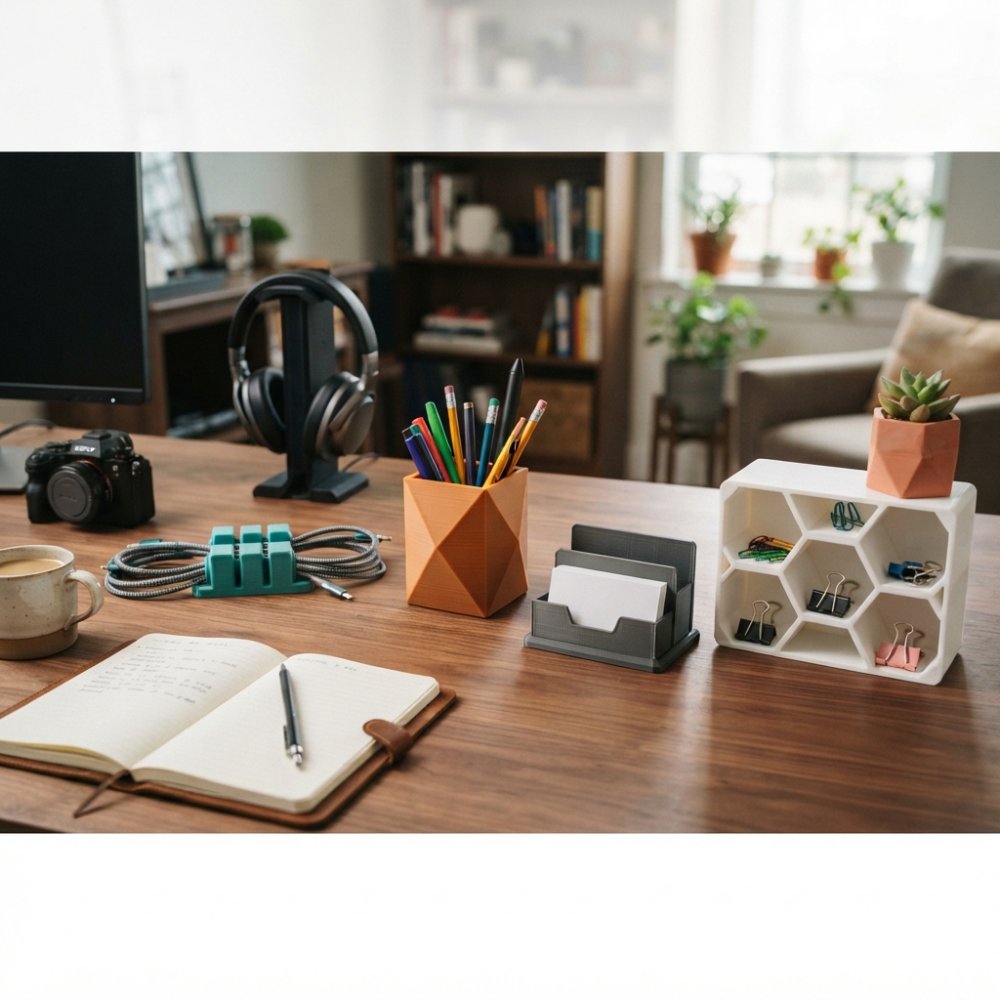
1. Card Game Case & Playing Card Holder
A dedicated card game case keeps everything organized, protected, and ready to play. The Card Game Case & Playing Card Holder from Bandit's Print Den is a hinged PLA case with integrated dividers designed specifically for tabletop gaming. It opens flat to reveal organized sections for different card piles during gameplay, then closes into a compact storage container.

What makes this work: The hinged design means you're not hunting for a separate organizer every game night. The integrated dividers eliminate scattered cards. At $10.00, it's affordable enough to keep multiple cases for different games. PLA is sufficient here because card cases don't experience flex stress.
2. Desk Organizers and Trays
Cable clutter and scattered supplies are workspace killers. Desk organizers and trays create zones for different items. 3D printed trays offer advantages over plastic alternatives: you can design dividers exactly where you need them, choose the tray depth that matches your desk dimensions, and print in colors that coordinate with your setup.
Print in PETG because trays see repeated handling and need to resist warping. Print flat (bottom-down) to maximize strength where it matters. Layer height of 0.2mm gives clean edges while maintaining structural integrity. Infill density of 15% is sufficient since trays aren't bearing heavy loads.
The real advantage: custom dimensions fit your desk perfectly where commercial organizers leave gaps.
3. Cable Management Solutions
Cable mess is the default state of most desks. 3D printed cable management clips can be positioned precisely where you need them, sized for your specific cables, and designed to stay put without damaging insulation.
Print cable clips in PETG with snap-fit joints that hold cables securely without pinching. Test your snap-fit tolerances on a small test print first. A 0.5mm clearance is usually the sweet spot. Cable channels that run along desk edges need wall thickness of at least 2mm. Infill density of 20% provides enough internal structure to support cable weight.
The critical detail: rounded edges on any cable contact point. Sharp corners cut insulation over time. Design your clips with 2mm radius curves where cables rest.
4. Pen and Pencil Holders
3D printed pen holders let you design compartments for different pen types. The design consideration that matters: hole sizing. Pens have different diameters. A 7mm hole works for standard ballpoints. Markers need 10-12mm holes. Pencils fit in 6mm holes. Print test pieces with different hole sizes and measure against your actual pen collection.
Pen holders don't experience stress, so PLA is acceptable. Print with 0.2mm layer height for clean edges. Infill density of 10% is sufficient. Sand the interior surfaces where pens rest with 220-grit sandpaper to smooth layer lines and prevent pen tips from catching.
5. Phone and Tablet Stands
Your phone or tablet needs an angle that works for your specific desk setup. Commercial stands are one-size-fits-all. 3D printed stands let you dial in the exact angle and height that matches your monitor and keyboard position.
Design the base in PETG with infill density of 25% to resist tipping. The contact surface should have slight texture, either print with a textured nozzle or sand with 120-grit sandpaper. Support arms should have wall thickness of at least 3mm. Print with 0.15mm layer height for smooth contact surfaces. Infill density of 20% provides enough internal structure without excessive weight.
6. Headphone Hangers and Stands
Headphones deserve better than tangled cables in a drawer. A dedicated hanger keeps them accessible and prevents cable damage from coiling stress. The critical design element: the contact surface where the headphone band rests. Narrow contact points create pressure spots that damage the headband over time. Design a curved support that distributes pressure across a wider area.
Print hangers in PETG for durability. Infill density of 20% is sufficient. Wall thickness of 2mm is adequate for the support arm. Include screw holes sized for your mounting hardware and test fit the screws in a test print before committing to the full version.
7. Modular Desk Shelving Systems
Modular shelving grows with your needs. Print individual shelf units that stack or connect, creating a custom storage system that fits your desk dimensions exactly. Design modular shelves with interlocking joints that snap together without fasteners. Test the joint tolerances on small samples first. A 0.3mm clearance usually works.
Shelf thickness matters for load capacity. A 5mm shelf supports light items. For heavier items, increase to 8mm thickness. Support arms should have wall thickness of 3mm and infill density of 25%. Print in PETG for structural durability. Layer height of 0.2mm balances strength with print time.
The advantage of modular design: if one shelf fails, you replace just that shelf, not the entire system.
How to Finish 3D Prints for Durability
Raw 3D prints have visible layer lines, rough surfaces, and limited aesthetic appeal. Finishing transforms a functional print into something you're proud to display and improves durability by smoothing stress concentrators.
Sanding and Surface Smoothing
Layer lines are structural weak points where prints can crack under stress. Start with 120-grit sandpaper for aggressive material removal, working in circular motions across the entire surface. This removes visible layer lines and high spots. Progress to 220-grit sandpaper for smoothing, which removes scratches left by 120-grit. For visible surfaces, finish with 400-grit sandpaper to create a polished appearance.
Sand in the direction of potential stress lines. If a part experiences bending stress, sand along the length of the bend. Wet sanding with water reduces dust and provides better surface feedback. Wear a dust mask regardless.
Sealing and Protective Coatings
Sealed prints resist moisture, UV damage, and general wear. Polyurethane is the practical choice for desk accessories. It's non-toxic when dry, applies easily with a brush, and creates a durable protective layer. Apply thin coats rather than one thick coat. Sand lightly between coats with 220-grit sandpaper to improve adhesion. Allow 24 hours between coats for full cure.
Epoxy resin offers higher durability but requires more careful application. For desk accessories that see daily handling, polyurethane is sufficient.
3D Printed Desk Organization Ideas for Maximum Workspace Productivity
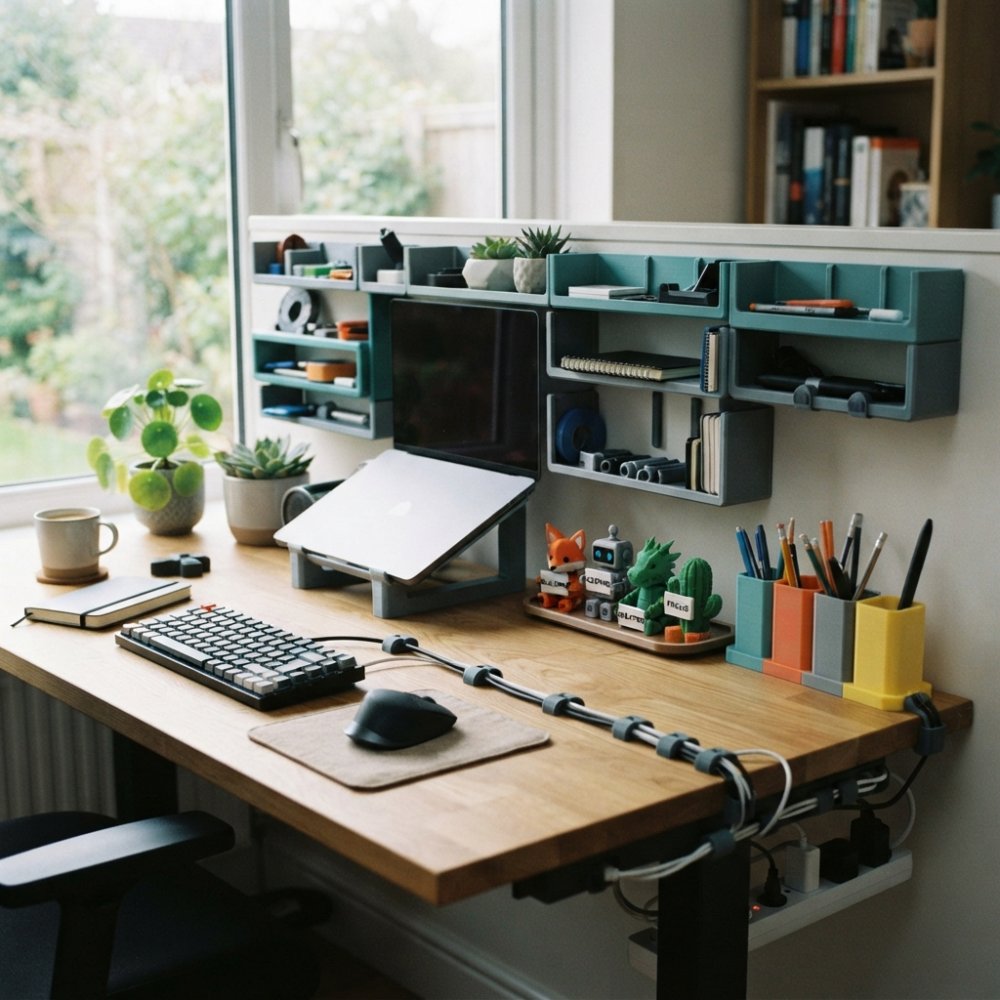
The best desk organization system is one you actually use. Generic systems fail because they don't match your workflow. Start by mapping your desk zones. Your monitor area needs cable management and a phone stand. Your writing area needs pen holders and paper trays. Your storage area needs modular shelving.
Combine functional pieces with personality. Desk buddies with interchangeable signs add character while serving as visual markers for different zones. The Elephant with Animals with Attitude at $8.00 doubles as a conversation starter and a workspace anchor.

Color coordination matters for visual organization. If your cable management clips are black, print your pen holders in a complementary color. This creates visual zones that help your brain organize information. When everything has a designated place, you spend less time searching and more time working.
Customization and Personalization for Your Workspace
Off-the-shelf desk accessories are designed for everyone, which means they're optimized for no one. 3D printing enables true customization. You can specify exact dimensions, choose colors that match your aesthetic, and design features that match your specific workflow.
Personalization goes beyond functionality. The Mummy with Holidays with Attitude at $8.00 brings humor to a workspace. The interchangeable signs let you change the mood based on your day. Color selection is personal. Some people prefer neutral tones that blend into the background. Others want bright colors that energize the space.

Articulated figures and desk buddies serve a psychological function beyond decoration. The Penguin with Animals with Attitude at $8.00 is designed to make you smile. That matters for daily workspace satisfaction. You can iterate by printing a version, using it for a week, then printing an improved version based on what you learned.
Maintenance and Cleaning Guides for Long-Lasting Accessories
3D printed accessories need minimal maintenance, but proper care extends their life significantly. Dust removal is the primary maintenance task. A soft brush removes dust without scratching the finish. For sealed prints, a damp microfiber cloth works well. For unsealed prints, dry brushing is safer.
Avoid harsh chemicals. Alcohol and acetone damage PETG and PLA. Use mild soap and water for cleaning. UV exposure degrades both PLA and PETG over time. If your desk sits in direct sunlight, rotate your accessories periodically or apply a UV-protective coating.
Temperature stability matters. Avoid placing hot items directly on 3D printed accessories. Use coasters or trivets as buffers between hot items and printed surfaces. For snap-fit joints in modular systems, occasional disassembly and reassembly is normal. If joints become loose over time, sand the male connector slightly to increase friction.
Inspect regularly for cracks or damage. Small cracks can be repaired with cyanoacrylate adhesive. For larger damage, reprinting the damaged piece is often faster than attempting repair.
The best desk accessories are ones that work for you, not against you. Durable 3D printed desk accessories solve this by letting you design exactly what you need. Start with one piece and expand from there as your workspace evolves.
Bandit's Print Den specializes in creating high-quality, durable 3D printed desk accessories that bring your vision to life. Whether you need a Card Game Case & Playing Card Holder to organize your gaming collection or personality-driven desk buddies like our Animals with Attitude collection, we print with precision and care. Our team, guided by Bandit's quality control expertise, ensures every piece meets durability standards and arrives ready to transform your workspace. Start building your personalized desk organization system today with accessories designed specifically for how you work.
Frequently Asked Questions
Q: What materials make 3D printed desk accessories most durable?
A: PLA and PETG are common filaments for desk accessories. PLA offers good strength with easier printing, while PETG provides durability and flexibility for items that experience frequent handling. ABS is another option for high-durability applications but requires more careful printing. The choice depends on your accessory's function: cable organizers benefit from PETG's flexibility, while storage trays work well in PLA. Infill density (15-20% for most desk items) and wall thickness (2-3mm) also affect durability.
Q: Are 3D printed desk accessories strong enough for daily office use?
A: Yes, when designed and printed correctly. Durable 3D printed desk accessories handle daily office tasks like holding pens, organizing cables, and supporting phones or tablets. The key is proper material selection, adequate wall thickness, and appropriate infill density. Layer lines and minor surface variations don't affect strength, they're normal characteristics of the 3D printing process and actually make each piece unique.
Q: How do I clean and maintain 3D printed desk organizers?
A: Clean 3D printed desk organizers with a soft, damp cloth and mild soap. Avoid abrasive scrubbers or harsh chemicals that can damage the surface. For stubborn dust, use compressed air or a soft brush. Dry thoroughly to prevent moisture absorption. If your organizer has been finished with a protective coating, cleaning becomes even easier. Store organizers away from direct sunlight to prevent color fading. Regular light dusting keeps them looking fresh and extends their lifespan significantly.
Q: Why choose custom 3D printed desk accessories over store-bought items?
A: Custom 3D printed desk accessories offer personalization, uniqueness, and functionality tailored to your specific workspace needs. Unlike mass-produced alternatives, each piece is made to order with attention to detail. You can customize colors, sizes, and designs to match your aesthetic and workflow. Bandit's Print Den delivers high-quality, articulated prints with fast shipping. Custom options also mean you get exactly what you need without paying for unnecessary features.
Q: What's the difference between PLA and PETG for desk accessories?
A: PLA is easier to print, produces cleaner details, and works well for decorative or light-duty organizers. PETG is more flexible and durable, making it ideal for cable management solutions and items subject to repeated stress. PLA is biodegradable but can become brittle over time in warm environments. PETG resists impact better and handles temperature fluctuations more gracefully. For most desk accessories, PLA offers excellent performance; choose PETG if your organizer needs to flex or endure frequent handling.
This article was written using GrandRanker
0 comments