
Table of Contents
- Best Materials for 3D Printing Stress Toys
- PLA Properties and Printability for Stress Toys
- TPU vs PLA for 3D Printing Fidget Toys
- Flexible Filament for Fidget Toys: Durability and Performance
- Print Settings and Infill for Maximum Strength
- 3D-Printed Toy Safety: What You Need to Know
- Real-World Durability: Design Choices That Matter
- Frequently Asked Questions
Last Updated: October 10, 2026
Best Materials for 3D Printing Stress Toys
When you're designing durable materials for 3D printed stress toys, the choice of filament can make or break the final product. A stress toy that cracks after two weeks of squeezing isn't a stress reliever, it's a waste of time and money.
Not all 3D printing materials are created equal for fidget toys. Some snap under pressure, others lose their satisfying feel after days. The best materials balance flexibility, durability, and printability, which is why PLA and TPU are the two workhorses of fidget production.
PLA is affordable, prints cleanly, and delivers crisp detail. TPU offers the rubbery give that makes squeeze toys satisfying. The challenge is knowing which fits your design, printer, and intended use.
PLA Properties and Printability for Stress Toys
PLA dominates the stress toy market because it's rigid, predictable, and forgiving. It prints at lower temperatures, requires minimal bed heating, and rarely warps, making it ideal for crisp articulated designs.
PLA holds intricate shapes without sagging and fails gracefully rather than suddenly. The trade-off: it doesn't bounce back after repeated squeezing and will crack at stress points after hundreds of flexes.
For clicky fidgets and rigid articulated designs, PLA is ideal. The SquishSpin fidget spinner uses PLA for its crisp edges, smooth surfaces, and ability to hold tight tolerances for satisfying tactile feedback.

PLA's printability advantage is real: no heated bed above 60°C, no enclosure needed, and most consumer printers handle it without issues. This means fewer failed prints, faster iteration, and lower material waste.
PLA's weakness: it cracks under sustained flexing. For designs with repeated bending, you'll need TPU, a hybrid approach, or a design that minimizes stress concentration.
TPU vs PLA for 3D Printing Fidget Toys
The TPU versus PLA decision comes down to one question: does your toy need to flex, or does it need to stay rigid?
TPU is flexible, rubbery, and bounces back after thousands of compressions. The downside: it's harder to print, requiring slower speeds, precise bed adhesion, and careful temperature management. Failed prints are common.
PLA prints reliably, holds crisp detail, and costs less, but it's brittle. It's ideal for toys handled gently, desk buddies, display pieces, and articulated figures that don't get squeezed.
Most stress toy designs benefit from a hybrid approach: PLA for the main structure and crisp details, TPU for high-stress joints and flex points.
The Flexi Manta Ray uses PLA because the design prioritizes visual appeal and articulated movement without extreme compression. For a squeeze toy requiring repeated compression, TPU or a hybrid structure would be necessary.

Flexible Filament for Fidget Toys: Durability and Performance
Flexible filaments like TPU deliver durability and satisfaction for squeeze toys. The magic happens when you can compress it, feel it resist, and watch it spring back.
TPU shore hardness ranges from 65A to 98A. For fidget toys, 80A to 95A is ideal, soft enough to feel satisfying, firm enough to hold shape and detail.
The durability challenge with flexible filaments is the printing process. TPU requires gentle handling: print speeds above 40mm/s cause layer separation, bed adhesion must be perfect, and temperatures vary by brand.
The real limitation is printability consistency. TPU is less forgiving of printer calibration errors. A slight nozzle temperature variance, a bed that's 5mm too high, or a cooling fan running too aggressively can ruin an entire print. That's why many small-scale producers use TPU selectively, reserving it for designs where flexibility is essential rather than nice-to-have.
| Material | Shore Hardness | Best For | Durability | Printability |
|---|---|---|---|---|
| PLA | Rigid | Articulated figures, clicky toys | 6-12 months (rigid use) | Excellent |
| TPU 80A-90A | Soft-firm | Squeeze toys, flex toys | 2-3 years (heavy use) | Moderate |
| TPU 65A-75A | Very soft | Ultra-squishy stress balls | 2-3 years (light-moderate use) | Difficult |
| PLA + TPU hybrid | Mixed | High-stress joints on rigid toys | 1-2 years (moderate use) | Good |
Print Settings and Infill for Maximum Strength
Here's where most people get it wrong: they assume higher infill means stronger toys. It doesn't. A toy printed at 40% infill with poor layer adhesion will fail faster than one at 15% infill with perfect layer bonding.
The real strength comes from how the layers stick together, not how many plastic walls you pack inside. Infill percentage affects weight, material cost, and print time, not durability in the way most people think.
For stress toys, we recommend 15-20% infill with a gyroid pattern. Gyroid infill distributes stress evenly across the structure, preventing weak points where failure initiates. It's also faster to print than grid or linear patterns, which means less time on the printer and fewer opportunities for something to go wrong.
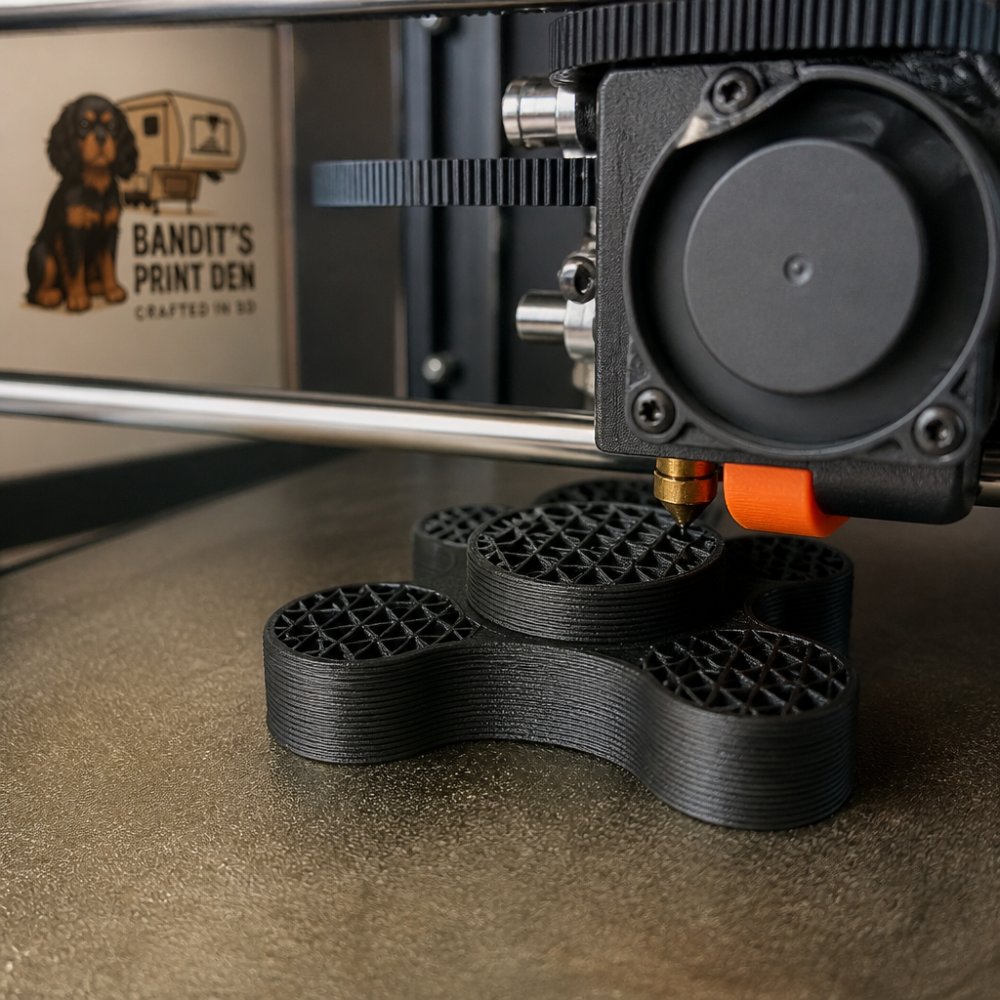
Print temperature matters more than infill. PLA prints best between 200-210°C. TPU works better at 220-235°C depending on the brand. Too hot and the material becomes stringy and weak. Too cool and layers don't bond properly. The difference between a toy that lasts and one that fails often comes down to a 5-degree variance.
Bed adhesion is non-negotiable. A toy that lifts off the bed mid-print is a failed toy. Use a textured bed surface, apply adhesive (glue stick for PLA, specialized TPU adhesive for flexible materials), and ensure your nozzle is properly leveled. The first layer determines everything.
Print speed should be conservative. We print stress toys at 30-40mm/s for PLA and 20-30mm/s for TPU. Faster speeds save time but compromise layer adhesion. Slower speeds cost more in electricity and printer time but deliver toys that actually survive real-world use.
SquishSpin 2" Textured Sensory Fidget Spinner | Bandit’s Print Den →
3D-Printed Toy Safety: What You Need to Know
Safety isn't optional when you're making stress toys. These objects get handled repeatedly, sometimes by children. They get mouthed, dropped, and stressed in ways you might not anticipate.
PLA is non-toxic and food-safe once cured, though it's not designed for ingestion. TPU is also non-toxic. Neither material is inherently dangerous. The risks come from design choices and printing quality.
Sharp edges and small detachable parts are the main concerns. If your articulated toy has a joint that can snap off and become a choking hazard, that's a design problem. If your stress toy has a sharp edge where support material was removed, that's a finishing problem. Both are preventable with thoughtful design and post-processing.
Layer lines and rough surfaces aren't safety issues, they're cosmetic. Customers sometimes worry that layer lines mean the toy will delaminate. They won't. Layer lines are just the visual signature of how 3D printing works. What matters is that those layers are bonded properly, which depends on print settings, not appearance.
If your toy will be used by children under 8, keep it large enough that no part can fit in a mouth. If it has articulated joints, make sure they're strong enough to survive aggressive play without breaking. If it's a squeeze toy, ensure the material won't tear under extreme compression.
Our Mini Fidgets are recommended for ages 3 and up, but they're small enough that they're not suitable for children under 3 due to choking risk. That's a design choice we made intentionally. The Infinity Cube is similarly sized and carries the same age recommendation. If you're designing for younger children, scale up and simplify.
Real-World Durability: Design Choices That Matter
Durability in 3D-printed stress toys isn't just about material selection. Design matters just as much. A poorly designed toy in TPU will fail faster than a well-designed toy in PLA.
Wall thickness is critical. Walls thinner than 1mm are fragile and prone to failure. Walls thicker than 3mm add unnecessary weight and cost without improving durability. The sweet spot is 1.5-2mm for most stress toys.
Stress concentration points are where toys fail. If you have a sharp corner where two walls meet at a 90-degree angle, that's where cracks initiate under repeated stress. Rounded corners and gradual transitions distribute stress more evenly and dramatically improve durability.
Articulated joints are the highest-risk areas. A joint that's too tight won't move. A joint that's too loose will wobble and fail. The tolerance needs to be precise, usually 0.2-0.3mm of clearance.
Orientation matters. How you orient the toy on the print bed determines how layers align with stress forces. If you're printing a squeeze toy, orient it so the layers run perpendicular to the compression direction.
The Infinity Cube's durability comes partly from its material (PLA) but mostly from its design. The hinges are reinforced, the walls are appropriately thick, and the overall structure distributes stress evenly. That's why it survives thousands of folds without failure.
Our Mini Fidgets last because they're small and don't experience extreme stress. The Flexi Manta Ray's articulated wings are durable because each joint is designed to flex gently, not to compress or bend sharply. Design and material work together.
Choosing durable materials for 3D printed stress toys means understanding the trade-offs between PLA's printability and TPU's flexibility. It means recognizing that infill percentage matters far less than layer adhesion and print temperature.
At Bandit's Print Den, every stress toy we create goes through this process. We test material combinations, dial in print settings, and design with durability as the primary goal.
Start with our SquishSpin 2" Textured Sensory Fidget Spinner if you want a durable, PLA-based fidget with crisp tactile feedback. For something more flexible and squeeze-friendly, the Flexi Manta Ray combines articulated movement with satisfying flex.
Get started with Bandit's Print Den and build stress toys that actually last. Free shipping on orders over $35.
Frequently Asked Questions
What is the most durable material for 3D-printed stress toys?
PLA and TPU are the top choices. PLA offers crisp detail and impact resistance at lower cost, making it ideal for toys that won't face extreme repeated squeezing. TPU provides superior flexibility and toughness, bouncing back after stress without cracking. For maximum durability under frequent handling, TPU edges ahead, but PLA with 20% infill and proper print settings delivers strong performance for most stress toys.
Is TPU or PLA better for a 3D-printed fidget toy?
It depends on the toy's design. PLA suits spinners and clickers that require crisp detail and smooth surfaces, like the SquishSpin, which uses PLA for its textured finish. TPU excels for squeeze toys and articulated fidgets that need flexibility and repeated-squeeze durability. Many stress toys use PLA because it's printable, affordable, and durable enough for moderate handling. Choose TPU if your toy will be squeezed hard and often.
How can I make a 3D-printed stress toy last longer?
Start with the right material: PLA for detail-heavy toys, TPU for squeeze toys. Use 15-20% infill with gyroid or grid patterns for strength without excess weight. Orient the print so stress loads align with layer lines. Avoid direct sunlight and heat above 140°F, as PLA softens. Clean gently with a dry cloth. Design wall thickness at 1.5-2mm minimum. Stress concentration points, like articulation joints, should be thicker or use flexible filament to absorb repeated strain.
Does infill percentage affect the strength of a 3D-printed stress toy?
Yes, significantly. Infill from 15-20% provides good strength-to-weight balance for most stress toys without excess material waste. Below 15%, toys become fragile under repeated squeezing. Above 20%, you gain minimal durability gain while increasing filament cost and print time. Infill pattern matters too: gyroid infill distributes stress more evenly than linear patterns, improving impact resistance and fatigue life under repeated handling.
Are flexible 3D-printed materials safe for toys that are mouthed or handled by children?
PLA and TPU are both non-toxic plastics commonly used in food-contact applications. However, 3D-printed toys may have small layer lines and surface imperfections that could pose choking hazards for very young children. Most 3D-printed stress toys are recommended for ages 3 and up. Check product labels for age guidance. If a toy will be mouthed frequently, ensure no small parts can detach, and clean regularly with mild soap and water.
0 comments