
Table of Contents
- What Defines High Quality 3D Printed Fidget Toys?
- Best Filament for Fidget Toys: PLA vs. PETG vs. ABS
- Top High Quality 3D Printed Fidget Toy Styles
- How to Spot Print Quality Issues Before You Buy
- Articulated 3D Printed Desk Buddies for Your Workspace
- How to Clean 3D Printed Fidgets and Keep Them Moving Smoothly
- Where to Buy High Quality 3D Printed Fidget Toys
- Conclusion
- Frequently Asked Questions
Last Updated: September 6, 2026
Not all 3D printed fidget toys are created equal. The difference between a toy that clicks satisfyingly for months and one that snaps in a week comes down to material, design tolerances, and post-printing care. This guide breaks down what separates a high quality 3D printed fidget toy from a frustrating novelty.

The market is flooded with cheap prints that look fine in photos but arrive with rough layer lines, stiff joints, or warped frames. We'll show you what to inspect, which filaments hold up, and how to keep your fidgets moving smoothly.
What Defines High Quality 3D Printed Fidget Toys?
A high quality 3D printed fidget toy is defined by three things: precise tolerances for moving parts, durable material selection, and clean surface finishing. If a print-in-place joint is too tight, it snaps; too loose, it rattles. The best makers calibrate their printers to a fraction of a millimeter so articulated segments move with consistent resistance.
Material matters as much as machine settings. A quality toy uses filament that resists layer separation and handles repeated stress without cracking. You should also see minimal stringing or rough edges, signs the maker tuned retraction settings properly.
Look for these markers of quality before you buy:
- Smooth, consistent layer lines across the entire surface
- Moving parts that flex or rotate without excessive force
- No visible warping, especially on flat bases or large sections
- A tactile finish that feels pleasant, not rough or sharp
- Consistent color and minimal visible seams
Best Filament for Fidget Toys: PLA vs. PETG vs. ABS
Most guides stop at saying "PLA is fine for desk toys," but that oversimplification leads to broken hinges. The real question is which material matches the mechanical stress profile of the specific fidget design.
PLA: The Crisp Default with a Heat Ceiling
PLA (polylactic acid) is the workhorse of the fidget world because it prints with exceptional dimensional accuracy, critical for print-in-place hinges that need a 0.2mm to 0.3mm gap to move freely. Its rigidity means crisp, tactile clicks and snap-fit joints. However, PLA has a glass transition temperature around 140°F (60°C); leave one on a car dashboard in July and you'll return to a warped, fused mess. For indoor desk use, PLA is tough enough for tens of thousands of flexes, but it is not a pocket-carry material for warm climates.
PETG: The Impact-Resistant Upgrade
PETG (polyethylene terephthalate glycol) is the smart choice when a fidget will face drops, pocket carry, or outdoor exposure. It has a higher glass transition temperature (around 176°F / 80°C) and significantly better layer adhesion than PLA, meaning a hinge is less likely to delaminate under repeated stress. The trade-off is surface finish: PETG prints with a slightly matte texture and can be prone to stringing if retraction settings aren't tuned perfectly. For a fidget that lives in a backpack or gets thrown around an office, PETG is the longevity pick.
TPU: The Overlooked Option for Squish and Flex
TPU (thermoplastic polyurethane) is a flexible filament that most fidget guides ignore. It's not for articulated dragons with rigid hinges, it's for squishy, compressible fidgets that provide a different sensory input. A TPU fidget cube or stress ball offers a soft, squeezable resistance that PLA and PETG cannot replicate. The catch is that TPU is harder to print (it requires direct-drive extruders and slow speeds) and its flex fatigue life depends heavily on the Shore hardness rating (e.g., 95A is firmer, 85A is squishier). If you see a maker offering a TPU fidget, they are printing on specialized equipment, that's a signal of a serious operation.
The Practical Decision Matrix
| Filament | Heat Resistance | Impact Resistance | Flex Fatigue Life | Surface Finish | Best Use Case |
|---|---|---|---|---|---|
| PLA | Poor (softens ~140°F) | Good for drops on carpet; brittle on hard floors | Good for thousands of flexes; cracks under sharp impact | Smooth, glossy, vibrant | Indoor desk toys, display pieces, articulated dragons |
| PETG | Good (softens ~176°F) | Excellent; bends rather than shatters | Excellent; resists layer separation | Slightly matte, can have minor stringing | Pocket carry, outdoor use, high-stress joints |
| TPU | Good (softens ~212°F+) | Excellent; absorbs impact | Excellent for compression; poor for sharp bends | Soft, rubbery, low detail | Squish toys, stress balls, sensory compression items |
| ABS | Good (softens ~220°F) | Good, but prone to warping during print | Good, but requires enclosure to print | Requires acetone smoothing for best feel | Advanced users with heated enclosures; rare for fidgets |
Why Material Choice Is a Durability Signal
The filament choice tells you more about the maker's priorities than any product photo. A maker who prints articulated dragons in PLA is optimizing for surface finish and color range, legitimate for a desk display piece. A maker who switches to PETG for pocket-sized fidgets is engineering for daily carry. A maker offering TPU options is catering to a different sensory need. When a listing specifies the filament and explains why it was chosen, you're looking at someone who understands the difference between a toy that looks good and a toy that lasts.
Top High Quality 3D Printed Fidget Toy Styles
The best high quality 3D printed fidget toys fall into two broad camps: articulated creatures that flex and pose, and mechanical fidgets with spinning or clicking actions. Both provide tactile feedback, but they serve different fidgeting styles. Articulated toys appeal to people who enjoy continuous movement and posing, while mechanical fidgets suit those who need repetitive, rhythmic stimulation.
Articulated Creatures and Flexi Toys
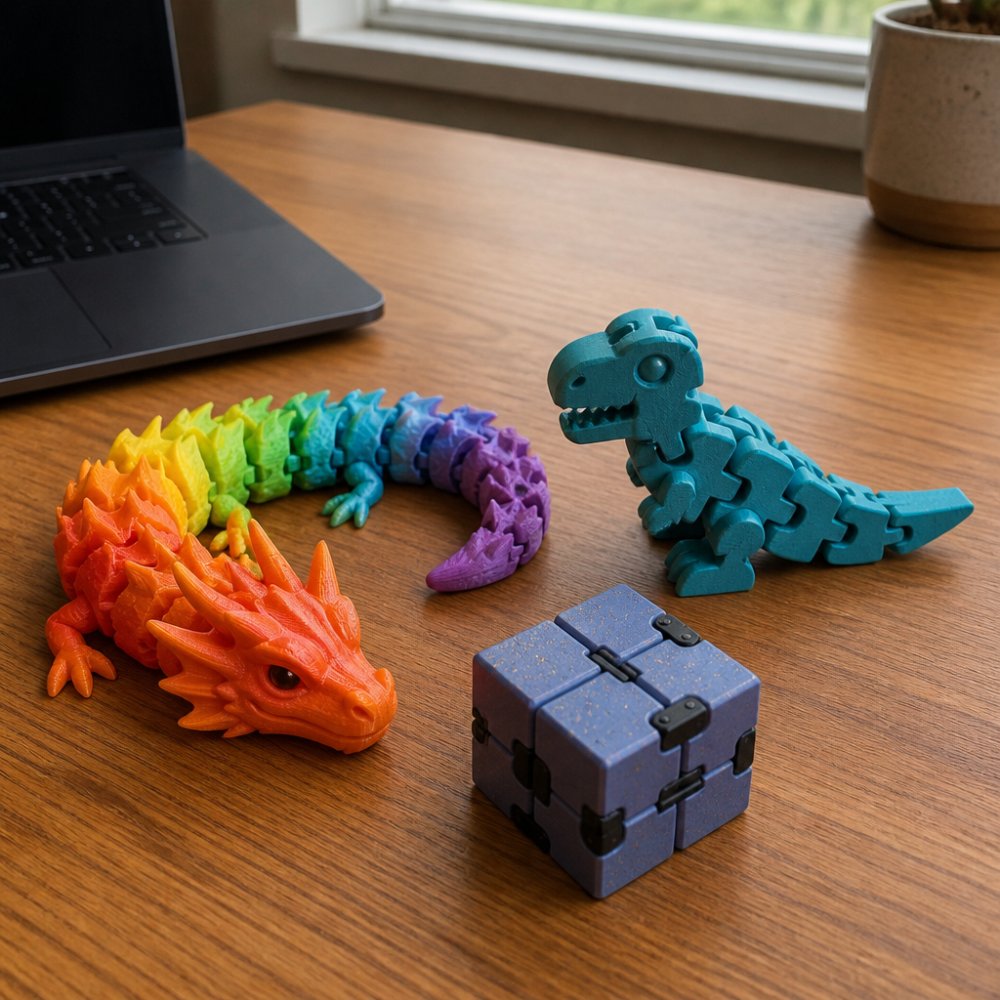
Articulated creatures, often called flexi toys, feature segmented bodies that bend and wiggle. These designs rely on print-in-place hinges, meaning the entire toy comes off the printer already assembled and moving. The best ones, like our Axolotl Dragon or Flexi Manta Ray, use carefully tuned gaps between segments so the toy flexes smoothly without breaking.
For a budget-friendly entry point, our Mini Fidgets at $5.00 each offer fully articulated movement in a pocket-sized package. They are perfect for testing whether you prefer a flexi motion or a clicking mechanism before committing to a larger piece.

Mechanical Fidgets: Spinners, Cubes, and Clickers
Mechanical fidgets rely on bearings, hinges, or snap-fit components to deliver their feedback. The Infinity Cube Fidget Toy folds and flips endlessly through eight connected cubes, while the SquishSpin combines two ball bearings with a textured surface for both spinning and clicking. These designs require the most precise calibration, as moving parts must fit together with tight tolerances.

How to Spot Print Quality Issues Before You Buy
Before you hit checkout, examine product photos for signs of poor printing. Look for visible gaps between articulated segments, which indicate loose tolerances, or rough, blobby surfaces that suggest poor extrusion calibration. A quality print should show uniform layer lines and clean edges, especially around moving parts.
Common red flags include:
- Warping: Curled edges or a bent base, often caused by poor bed adhesion during printing
- Stringing: Thin wisps of plastic between parts, a sign of improper retraction settings
- Zits or blobs: Small bumps on the surface from inconsistent extrusion
- Cracked joints: Visible stress marks near hinges or snap-fit connections
A common mistake is assuming all 3D printed items look the same. They do not. A maker who posts close-up photos of their layer lines and discusses calibration openly is usually more confident in their output. If a listing only shows stylized renders or heavily filtered images, ask for real photos of the actual product.
Articulated 3D Printed Desk Buddies for Your Workspace
Articulated 3D printed desk buddies have become a staple of modern workspaces, offering a small moment of play during long workdays. A desk buddy is any small, poseable figure that sits beside your monitor, ready for a quick fidget break. The T-Rex Dinosaur with its movable jaw and articulating limbs makes a statement at 15.5 inches long, while the smaller version fits neatly beside a keyboard.
For collectors who want something truly conversation-starting, the XXL Flexi T-Rex Skeleton stretches 36 inches across a desk or shelf. Its hinged jaw and fully poseable spine turn it into an interactive display piece. What most guides miss is that desk buddies serve a real purpose beyond decoration: they give your hands a micro-break from typing, which can reduce the urge to check your phone or bounce your knee.
How to Clean 3D Printed Fidgets and Keep Them Moving Smoothly
Cleaning and maintenance are only half the story. The real frustration for most owners is when a print-in-place fidget arrives or becomes stiff, joints that should flex freely are fused, grinding, or catching. This section covers routine upkeep and troubleshooting steps that most guides skip.
Routine Cleaning: What Works and What Destroys Your Toy
Start with the basics: a soft, dry microfiber cloth removes the skin oils and dust that accumulate on the surface. For joints and crevices, use a soft-bristled brush (a clean toothbrush works) or a can of compressed air to dislodge debris. Avoid water for PLA, it's porous and can cause micro-swelling that tightens already-tight hinge gaps. PETG and TPU are more water-resistant, but dry cleaning is still safer for all materials.
- Weekly: Wipe down with a dry microfiber cloth to remove oils
- Monthly: Brush out dust from joints with a soft brush or compressed air
- Quarterly: Inspect hinge points for hairline cracks or stress whitening
Lubrication: The Micro-Drop Rule
For mechanical fidgets, spinners, clickers, and hinged cubes, lubrication is the difference between a satisfying action and a grinding one. Use a light machine oil (like sewing machine oil) or a dry PTFE lubricant. Apply a single micro-drop to the hinge or bearing point, then cycle the joint 20-30 times to distribute it. Wipe away any excess. More lubricant is not better; excess oil attracts dust and turns into a gritty paste.
Troubleshooting Stiff or Fused Print-in-Place Joints
If a print-in-place fidget arrives with joints that won't move, or if a previously smooth toy stiffens up, here's the diagnostic sequence:
1. Identify the type of stiffness.
- Completely fused (won't budge at all): The hinge gap was too small, or the print experienced 'elephant's foot', where the first layer squishes out wider than intended, fusing the joint at the base.
- Gritty or grinding: Debris or dust is trapped in the gap, or the surface has rough layer lines catching on each other.
- Tight but movable: The gap is at the low end of tolerance; it may loosen with use or need a slight mechanical intervention.
2. The cold-break method for fused joints. Place the toy in a freezer for 15-20 minutes. PLA and PETG become slightly more brittle when cold, but the differential contraction can crack the thin fused bridges between segments without breaking the main structure. After removing from the freezer, firmly but gently flex the joint. If it doesn't break free on the first attempt, repeat the cycle once. Do not force it, if it doesn't move after two cycles, the fusion is too thick.
3. The controlled flex technique. For joints that are tight but movable, work the joint through its full range of motion 50-100 times in a slow, deliberate manner. This 'wearing-in' process can smooth out minor surface irregularities. If you hear clicking or catching, inspect the joint under bright light for a small blob or stringing, remove it with a hobby knife.
4. When to return it. If a joint is completely fused and doesn't respond to the cold-break method, or if you see stress whitening (a white, cloudy appearance) at the hinge point after forcing it, the toy has a design or printing defect. A quality maker will replace it. A quality maker will replace it.
The Maintenance Schedule That Keeps Fidgets Moving
| Frequency | Action | Tools |
|---|---|---|
| Weekly | Dry wipe surface | Microfiber cloth |
| Monthly | Brush joints, check for debris | Soft brush, compressed air |
| Quarterly | Lubricate mechanical joints | Light oil or PTFE lube, cloth |
| As needed | Cold-break fused joints | Freezer, patience |
Where to Buy High Quality 3D Printed Fidget Toys
For guaranteed quality, buy from a maker who prints to order and inspects each piece before shipping. For guaranteed quality, buy from a maker who prints to order and inspects each piece before shipping.
Look for sellers who are transparent about their materials and licensing. A maker who holds commercial licenses for their designs, as we do for our Halloween Dumpling Clickers and Axolotl Dragon, signals a professional operation. You are also supporting the original designers, not just the printer.
Shipping speed matters, especially for gifts. Our made-to-order pieces ship fast, and orders over $35 ship free. If you need a specific piece by a date, contact us before ordering so we can confirm the timeline.
Conclusion
Finding a high quality 3D printed fidget toy comes down to understanding materials, checking print quality, and buying from makers who treat calibration as a craft. Whether you prefer the endless motion of an Infinity Cube or the poseable charm of an articulated dragon, the right toy will survive years of fidgeting.
The challenge is separating genuine quality from mass-produced prints that look good in photos but fail in your hands. At Bandit's Print Den, we print every piece to order, inspect each toy personally, and stand behind the durability of our PLA prints. Browse our collection of articulated fidget toys and find a desk buddy that will keep your hands busy for years to come.
Get started with Bandit's Print Den and add a high quality, hand-inspected fidget to your collection today.
Frequently Asked Questions
What makes a 3D printed fidget toy high quality?
High quality 3d printed fidget toys come down to three things: material, print settings, and finishing. A premium toy uses durable PLA or PETG filament with tight layer adhesion, so joints don't snap after a few fidget sessions. The print should have clean, consistent layers without visible gaps or stringing. Articulated parts should move smoothly right off the print bed, and any post-processing should remove rough edges. A quality piece feels solid in your hand, not brittle or flimsy.
What is the best filament for fidget toys?
PLA is the best filament for fidget toys for most buyers. It's rigid, prints with tight tolerances for smooth mechanical movement, and is food-safe and non-toxic, making it safe for desk use. PETG is a better choice if you need extra durability or plan to leave your fidget in a hot car, since it resists warping at higher temperatures. ABS offers impact resistance but requires a heated enclosure to print well. For everyday fidgeting, high-quality PLA gives the best balance of smooth motion and longevity.
Are 3D printed fidget toys safe for children?
Many 3D printed fidget toys are safe for children, but you need to check the specific product. PLA filament is non-toxic and generally safe, but articulated toys contain small moving parts that can be a choking hazard for children under 3. Look for toys with a recommended age of 3+ or 8+. Also verify the toy has no sharp edges or loose pieces. For younger kids, choose simpler designs with larger parts and always supervise play.
How do you maintain articulated 3D printed fidget toys?
To keep articulated 3D printed fidget toys moving smoothly, clean them regularly with a soft, dry cloth to remove dust and skin oils. For deeper cleaning, use a slightly damp cloth, but dry thoroughly afterward since moisture can affect PLA. Avoid leaving PLA fidgets in direct sunlight or hot environments, as the material can soften and deform. If a joint feels stiff, work it back and forth gently to loosen it. Never use chemical cleaners or solvents, as they can break down the plastic.
Where can I buy custom-made 3D printed desk accessories?
For custom-made 3D printed desk accessories, look for small studios that offer personalized work rather than mass-produced items. You can order ready-made pieces like the Infinity Cube for $5.00 or request a fully custom figure by describing what you want. Custom orders let you choose colors, sizes, and designs that fit your workspace. Free shipping applies on orders over $35, making it easy to bundle a few pieces.
0 comments