
Table of Contents
- How 3D Printing Fidget Toys Support ADHD Focus
- Best Print-in-Place Fidget Toys for Busy Hands
- Articulated 3D Printed Figures for Stress Relief and Focus
- Durable Materials for 3D Printed Fidgets That Last
- Choosing the Right Fidget for Your Needs
- Safety and Maintenance Tips for 3D Printed Fidgets
- Frequently Asked Questions
Last Updated: September 15, 2026
How 3D Printing Fidget Toys Support ADHD Focus
Fidgeting isn't a distraction problem. It's a regulation strategy. For a lot of people with ADHD, giving restless hands a small, repetitive job frees up attention for the actual work. A well-designed fidget provides that outlet quietly, without pulling focus the way a phone or a snack would.
This is where 3d printing fidget toys for adhd focus earns its keep. Printed fidgets can be tuned in ways mass-produced ones can't: you control the weight, the grip size, the texture, and the resistance of every moving part. At Bandit's Print Den, we print each piece to order and inspect it before it ships, which means the tolerances you get are the tolerances we checked.
The Science of Fidgeting and Concentration
Fidgeting is a self-regulation behavior, not a sign of boredom. Many researchers and clinicians describe it as a way to regulate arousal and keep the brain at an alert-but-calm level, which is why movement often increases during demanding tasks rather than easy ones.
The practical takeaway: the goal isn't to stop fidgeting. It's to redirect it into something low-noise and low-visual. A quiet, repetitive motion gives the restless part of your attention somewhere to go while the rest of your brain stays on task. That's the entire design brief for a good focus fidget.
Best Print-in-Place Fidget Toys for Busy Hands
Print-in-place fidgets are printed as one complete unit with moving parts already assembled, so nothing needs to be snapped together or glued. That construction is what makes them durable: fewer joints, fewer failure points, and no tiny pieces to lose.
If you're shopping rather than printing, the same design principle applies. Look for a single continuous mechanism rather than something with separate fasteners.
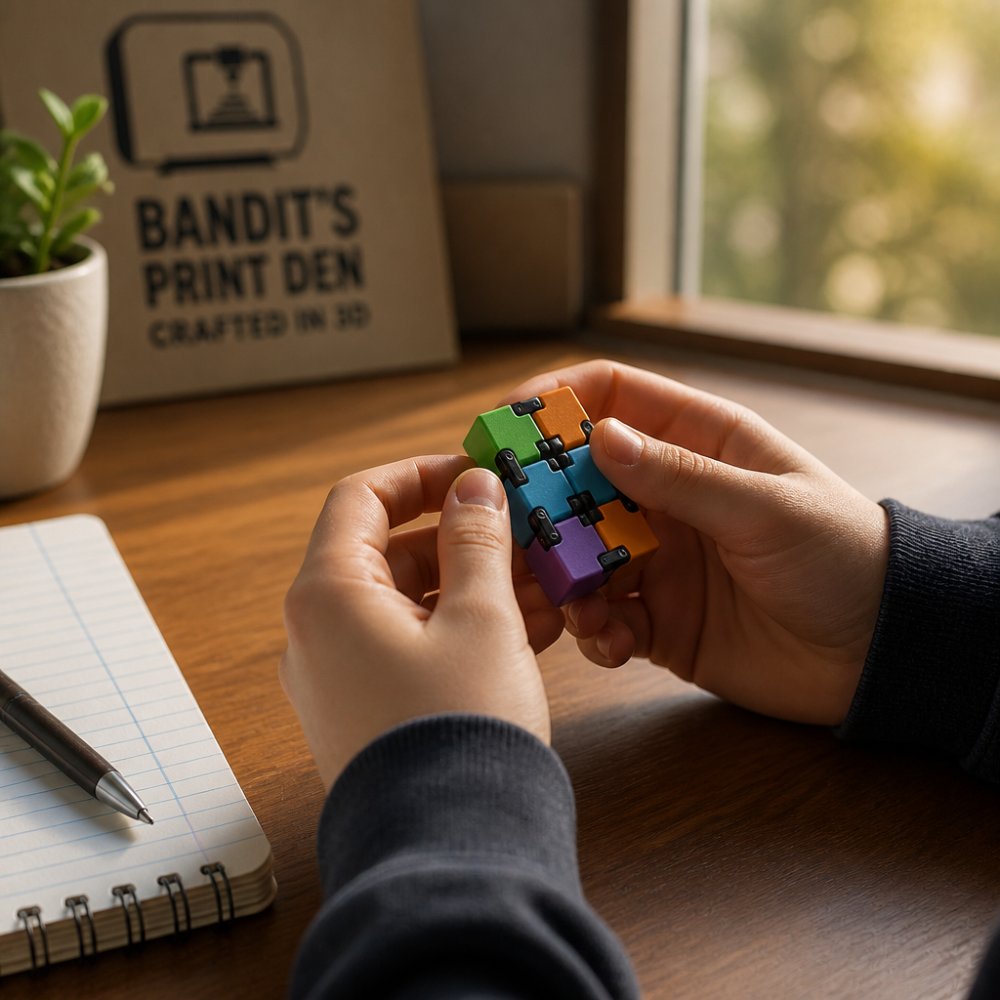
- Infinity Cube ($5.00): A 1.5-inch folding cube that flips and folds endlessly without coming apart. Small enough for a pocket, quiet enough for a meeting.
- SquishSpin 2" Textured Spinner ($13.00): Two ball bearings plus a textured surface, so you get smooth rotation and tactile input from the same object.
- Mini Fidgets ($5.00): Fully articulated pocket creatures. Buy four, get one free at checkout.
| Fidget | Price | Movement Type | Best For |
|---|---|---|---|
| Infinity Cube | $5.00 | Folding, continuous | Desk and pocket use |
| SquishSpin Spinner | $13.00 | Smooth rotation | Tactile + motion seekers |
| Mini Fidgets | $5.00 | Articulated flex | Collectors, fidget variety |
| Songbird Water Whistle | $9.00 | Auditory | Sound-based sensory input |
One honest limitation: print-in-place parts have a break-in period. A fresh hinge can feel stiff for the first day or two. That's normal, and it loosens with use.


Articulated 3D Printed Figures for Stress Relief and Focus
Articulated 3D printed figures are models built from interlocking segments printed as a single piece, so the body bends and poses without assembly. The repetitive flexing motion is the point: it's slow, quiet, and rhythmic, which is exactly the profile that supports decompression during a focus break.
Here's where most buying guides stop short. They list models without explaining that articulation quality varies enormously between prints. A well-tuned print moves smoothly through its full range. A poorly tuned one binds, grinds, or flops. That difference comes down to printer calibration and material choice, not the design file.
For heavier sensory input, size matters. A larger articulated piece gives you more resistance through the joints and a more substantial feel in the hand:
- Flexi Manta Ray ($10.00): Just over 5 inches wide, with multiple moving sections across the wings and a rainbow finish.
- T-Rex Dinosaur ($13.00): Available in two sizes, with an articulating tail, legs, arms, and a movable jaw.
- Axolotl Dragon ($14.00): Roughly 25 to 28 inches long, fully articulated, no assembly required.
- Fully Articulated Iguana ($30.00): 12 inches long with a rotating head and four-color gradient finish.
Durable Materials for 3D Printed Fidgets That Last
Filament choice changes how a fidget feels in your hand more than the model file does. Two identical infinity cubes printed in different materials are not the same object to your nervous system. One is slick and light; the other is grippy and dense. If you're choosing a fidget for ADHD focus, that difference matters more than color.
Here's how the common filaments actually behave in a moving, hand-held part:
- Standard PLA: Smooth, slightly slick, and dimensionally precise. It holds tight tolerances in hinges and bearings, which is why it's the default for print-in-place mechanisms. Downsides: it's brittle under repeated flexing and softens in heat. A PLA fidget left on a dashboard in summer can warp out of tolerance.
- PLA+ / Tough PLA: Same print behavior as standard PLA with noticeably better impact resistance. If you tend to drop or pocket-carry a fidget, this is the upgrade that matters. Feel is nearly identical to standard PLA.
- PETG: Slightly more flex and much better heat resistance than PLA. The surface has a faintly waxy, grippier hand feel that some people find more satisfying for texture-seeking. It strings more during printing, so hinge gaps can be less crisp.
- TPU (flexible): This is the material most guides skip, and it's the one that changes the sensory experience the most. TPU bends, squishes, and rebounds. For someone whose restlessness is satisfied by squeezing rather than clicking, a TPU fidget outperforms every rigid option. Trade-off: TPU is hard to print with fine articulated joints, so it works best for solid squish shapes rather than multi-segment mechanisms.
- Matte / textured PLA: A surface finish rather than a different plastic, but it adds friction and a softer hand feel. Good for people who want more tactile input from the same shape.
- Gradient and dual-color PLA: Purely visual. The color shift gives your eyes something to track during a break, which is a legitimate secondary sensory channel.
Infill and wall count are the other half of the equation. A fidget printed at 15% infill feels hollow and light; the same model at 40% infill with three walls feels substantial and grounded. For people who find lightweight fidgets unsatisfying, mass is the fix, and it costs nothing but print time.
A quick decision path:
- Want crisp, quiet mechanism? Standard PLA or PLA+.
- Want heat tolerance and a grippier surface? PETG.
- Want to squeeze and stretch? TPU.
- Want more weight in the hand? Higher infill, not a different filament.
If you want a deeper grounding in how plastics behave under heat and stress, the UL Standards & Engagement materials guidance covers material behavior in plain terms. For a plain-language overview of what fidgeting does for attention, the ADDitude Magazine resource library is a solid starting point.
Choosing the Right Fidget for Your Needs
The right fidget matches your sensory preference, not the trend. People seek different kinds of input, and a fidget that feels great to one person can feel irritating to another. Work backward from what your hands actually want.
Use this to narrow it down:
- If you need motion: a spinner or folding cube.
Safety and Maintenance Tips for 3D Printed Fidgets
Cleaning articulated and print-in-place fidgets
Fixing common wear-and-tear
Safety considerations
Printer settings that prevent problems before they start
Frequently Asked Questions
Do fidget toys actually help with ADHD focus?
Yes, for many people with ADHD, fidgeting can help with self-regulation and concentration. Research suggests that engaging in repetitive motion or tactile stimulation can help the brain maintain an optimal level of arousal for focus, especially during tasks that require sustained attention. However, the effectiveness varies from person to person, and it's important to find a fidget that works for you without becoming a distraction itself.
What are the best print-in-place fidget toys for ADHD?
The best print-in-place fidgets are those that offer smooth, satisfying movement without requiring assembly. Popular options include the Infinity Cube, articulated creatures like the Flexi Manta Ray, and gear spinners. When choosing, look for designs with comfortable ergonomic grip. Bandit's Print Den offers several print-in-place fidgets that are well-suited for ADHD focus.
How do articulated 3D printed figures help with stress?
Articulated figures, such as flexi dinosaurs or dragons, provide a calming effect through repetitive motion. Bending, posing, and flexing the joints engages fine motor skills and provides tactile feedback that can help manage anxiety and stress. The focus required to manipulate the figure can also serve as a grounding technique, redirecting attention away from stressors and toward a soothing, repetitive activity.
What materials are best for durable 3D printed fidgets?
PLA is the most common material for 3D printed fidgets due to its ease of printing, wide color availability, and sufficient durability for everyday use.
Finding a fidget that actually helps with focus is a trial-and-error process, and the mass-produced options rarely fit anyone perfectly. Bandit's Print Den prints every piece to order in our mobile fifth-wheel workshop, with Bandit handling quality control on each one. You get custom color requests, articulated figures that move the way they should, and free shipping on orders over $35. Browse the collection and add to cart to find the fidget that fits your hands.
0 comments